


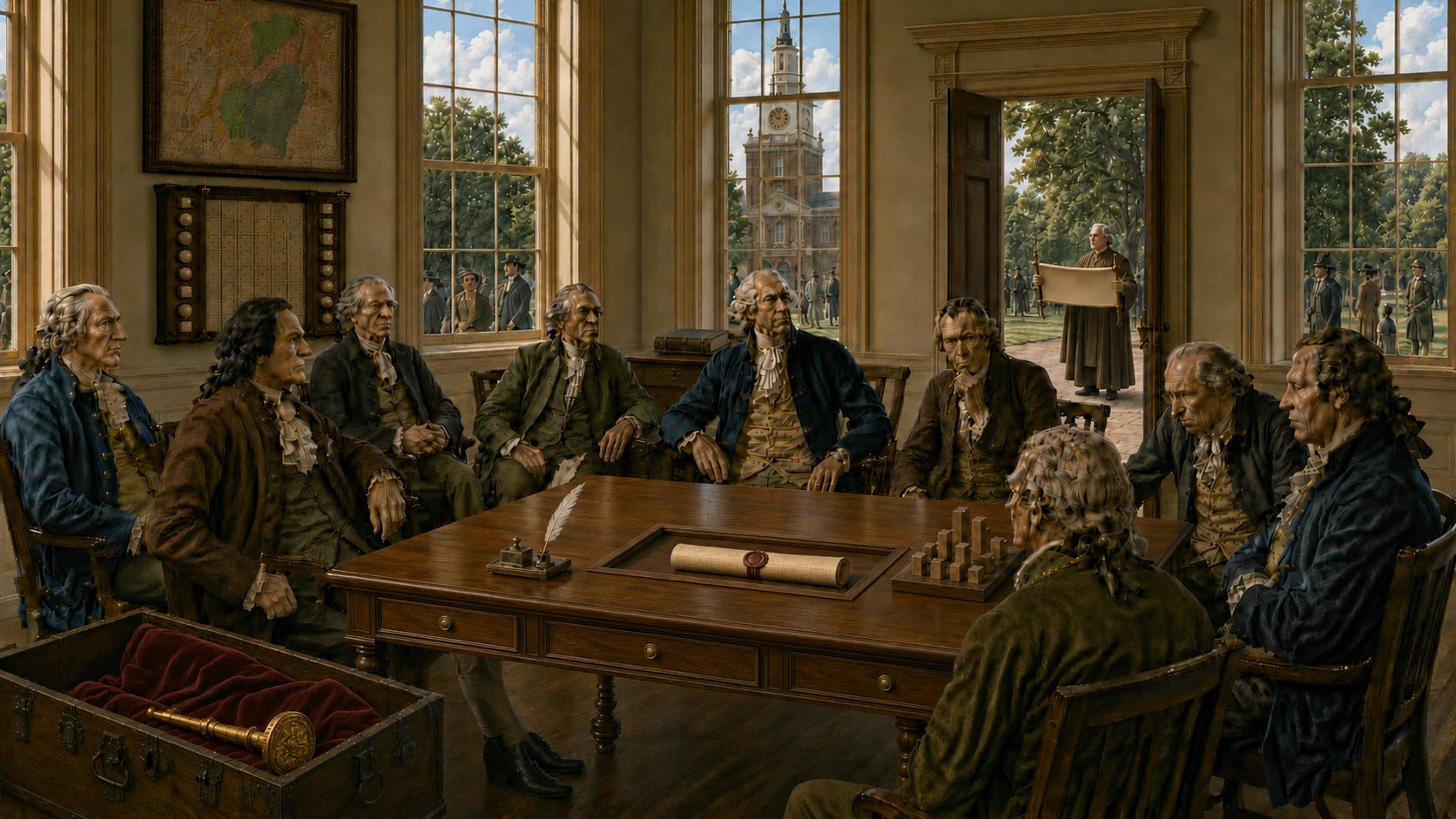
The American constitutional order gives religion broad protection in conscience, worship, community life, moral formation, education, charity, and public persuasion. Religious conviction may shape Citizens, families, institutions, and public argument.
Civil authority follows a different path. It must derive from Citizen sovereignty, constitutional office, lawful jurisdiction, due process, equal protection, rights constraints, and review. The constitutional danger begins when religious authority starts producing civil consequences while bypassing that path.
The Constitution emerged from a civilization shaped by biblical religion, natural law reasoning, covenantal political thought, Protestant and dissenting theories of conscience, common-law inheritance, classical republicanism, and Enlightenment constitutionalism. Its language of oath, office, duty, justice, liberty, rights, moral agency, public virtue, and accountability arose from a world where religion formed much of the moral imagination of public life. A serious reading of the American republic can recognize the Judeo-Christian inheritance of the Founding world and the religiously informed moral anthropology that helped form the background assumptions of constitutional government.
That inheritance gives the republic a moral grammar. Civil authority runs through a constitutional operating structure. The Constitution presupposes that Citizens and officeholders may be morally serious, conscience-bound, oath-bound, and accountable before the Creator, while locating public civil authority in the Constitution itself. Religious inheritance may shape the moral imagination of a people. It may inform public reason, civic virtue, and the conscience of legislators, judges, executives, and Citizens. Civil law receives its public force through constitutional authority.
The constitutional problem begins when religious authority is asserted as a source of civil rule. This article uses the term theological claims to civil authority to describe attempts to make religious doctrine, sacred law, clerical interpretation, ecclesial office, or confessional status produce civil consequences in law, officeholding, adjudication, representation, citizenship, rights, enforcement, or public records without passing through the Constitution and its republican chain of authority.
Nothing in this analysis limits the right of religious Citizens to advocate for laws consistent with their moral convictions through ordinary republican processes. Religious Citizens may worship, organize, persuade, vote, legislate, litigate, educate, and advocate from religious conviction. A religious argument remains part of republican public life when it enters the civil order through constitutional offices, procedures, rights, limits, and review. The boundary concerns authority, not motivation.
This is a governance problem before it is a cultural problem. The institutional questions are direct.
What is the source of public authority?
Who may make law?
Who may interpret law?
What is the status of Citizens who hold different beliefs?
What rights remain secure against ordinary political control?
What offices exist, how are they filled, and what oath binds their occupants?
What system governs conflicts between religious command and civil law?
The Constitution answers those questions through a republican system of delegated and enumerated authority. Public power is lawful when it is derived from the Constitution, enacted through constitutionally specified institutions, exercised by officers bound by Oath or Affirmation, and constrained by rights and structural limits. The Constitution protects religious exercise, prevents the establishment of religion as civil authority, and bars religious tests for public office. Religious liberty belongs fully inside the republic. Civil authority must remain constitutionally derived.
United States Protocol and USP2P treat constitutional government as a derivation system. In that model, the Constitution and Bill of Rights function as the L1 immutable security layer; Congress, states, courts, and the Executive operate through constrained validation, execution, and review; United States Protocol expresses constitutional roles, powers, offices, thresholds, jurisdictions, and procedures as executable civic logic; and USP2P provides the citizen-operated continuity and settlement layer that anchors civic state in proof-bearing form.
The comparison is useful because religious authority and constitutional protocolism answer the same institutional question through different derivation paths. A religious-law claim may enter public life as moral argument, conscience, custom, or voluntary association. Civic authority derives from constitutional identity, jurisdiction, office, apportionment, consent, lawful execution, and observable continuity.
