


The Economic Engine of the American System
The United States Constitution created the most successful framework for free-market capitalism in human history. The rise of the American economy emerged from a constitutional system designed to preserve liberty, constrain centralized power, protect property, enforce contracts, distribute authority, and allow productive citizens to build freely across generations.
The Founding generation understood that prosperity grows from lawful liberty, private initiative, and productive coordination across society. Wealth is created when free individuals are free to pursue enterprise, specialization, exchange, invention, investment, and production within a stable legal framework. Adam Smith described this through the concept of the invisible hand: the distributed coordination of economic activity through voluntary action, local knowledge, market signals, and the pursuit of productive self-interest. Millions of independent decisions collectively produce markets, industries, innovation, and wealth creation at civilizational scale.
The American constitutional order created the conditions under which this process could flourish more effectively than anywhere else in the world. The U.S. Constitution established a durable civic framework where productive citizens could accumulate capital, organize businesses, deploy infrastructure, engage in commerce, and build institutions with confidence that the rules themselves possessed continuity. This long-term stability became one of the greatest economic advantages in human history.
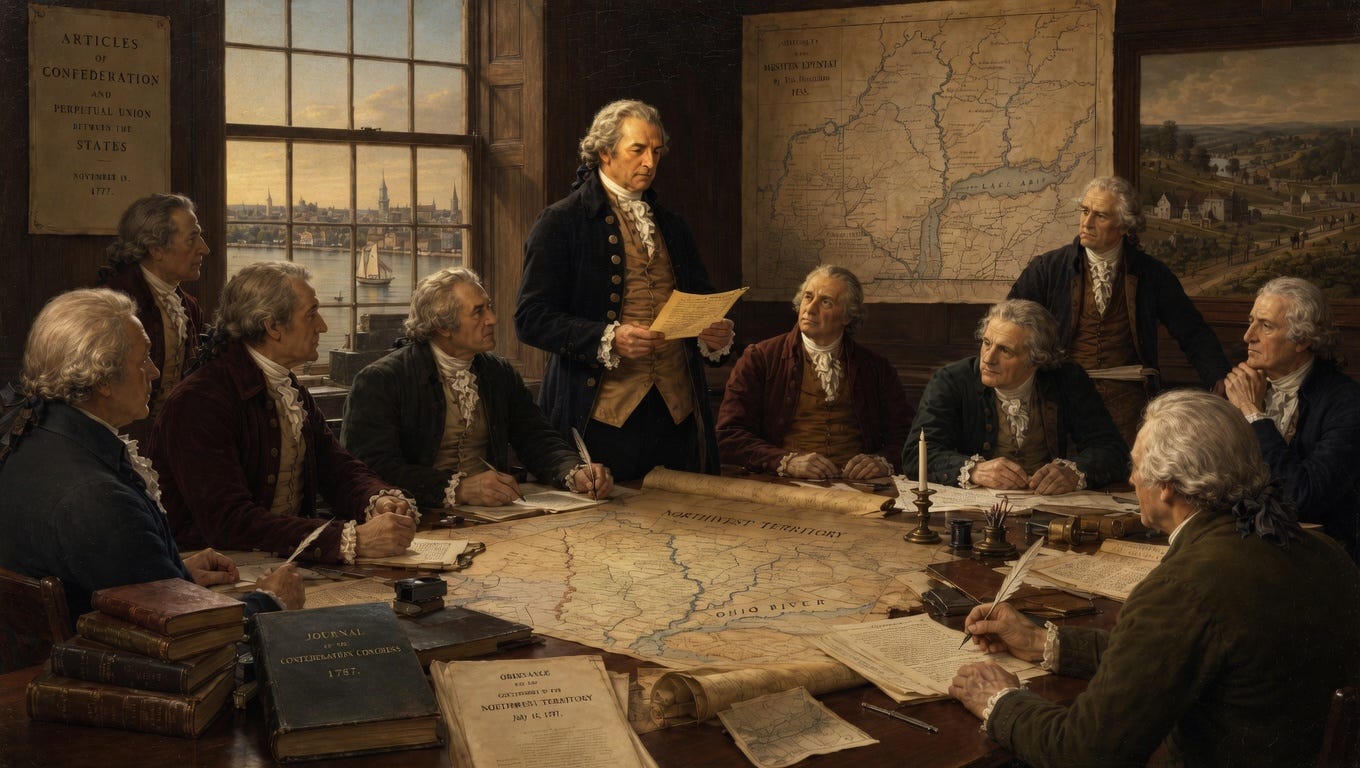
The Northwest Ordinance of 1787 provides an early and powerful illustration of this same logic. The ordinance created a lawful structure for settlement, property, education, republican government, and future statehood in the Northwest Territory. It showed how legal architecture could transform land into a future republic of property-holding citizens, local institutions, commerce, improvement, and ordered liberty. The Constitution then supplied the national architecture capable of carrying that logic across a continental republic.
The U.S. Constitution as Market Infrastructure
Protocolism extends this understanding into the digital era by interpreting the U.S. Constitution as a governance protocol specification: a system of defined authorities, constraints, procedures, permissions, prohibitions, and lawful state transitions. Under this framework, the Constitution becomes operational infrastructure for free civilization. Its structure can be analyzed politically, legally, systemically, and economically.
