


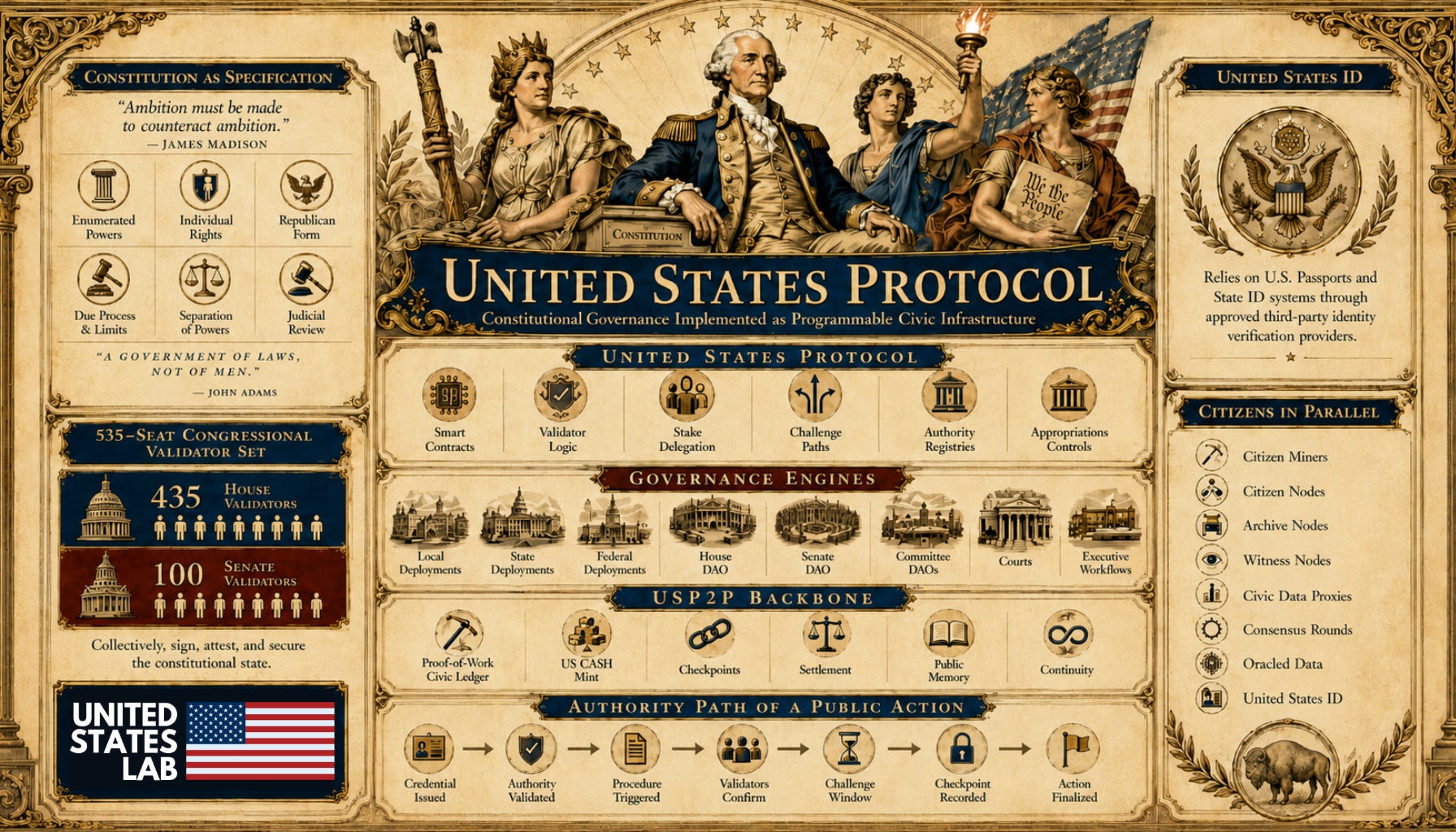
United States Protocol uses programmable governance technology to implement the United States Constitution as an operational civic system. Blockchain, smart contracts, zero-knowledge proofs, digital credentials, validator networks, and peer-to-peer infrastructure are the implementation environment. The U.S. Constitution is the specification.
This means the protocol is designed around authorized powers, offices, procedures, rights constraints, jurisdictional boundaries, elections, oaths, appropriations, bicameralism, federalism, judicial review, and amendment paths. These are the operating requirements the system is built to execute.
United States Protocol translates constitutional structure into executable governance logic. A public action becomes valid when it moves through the proper authority path: the right actor, the right office, the right clause, the right procedure, the right jurisdiction, the right record, and the right opportunity for challenge or review.
The purpose of the blockchain infrastructure is to give constitutional self-government a programmable, auditable, tamper-resistant, and citizen-verifiable execution layer.
