


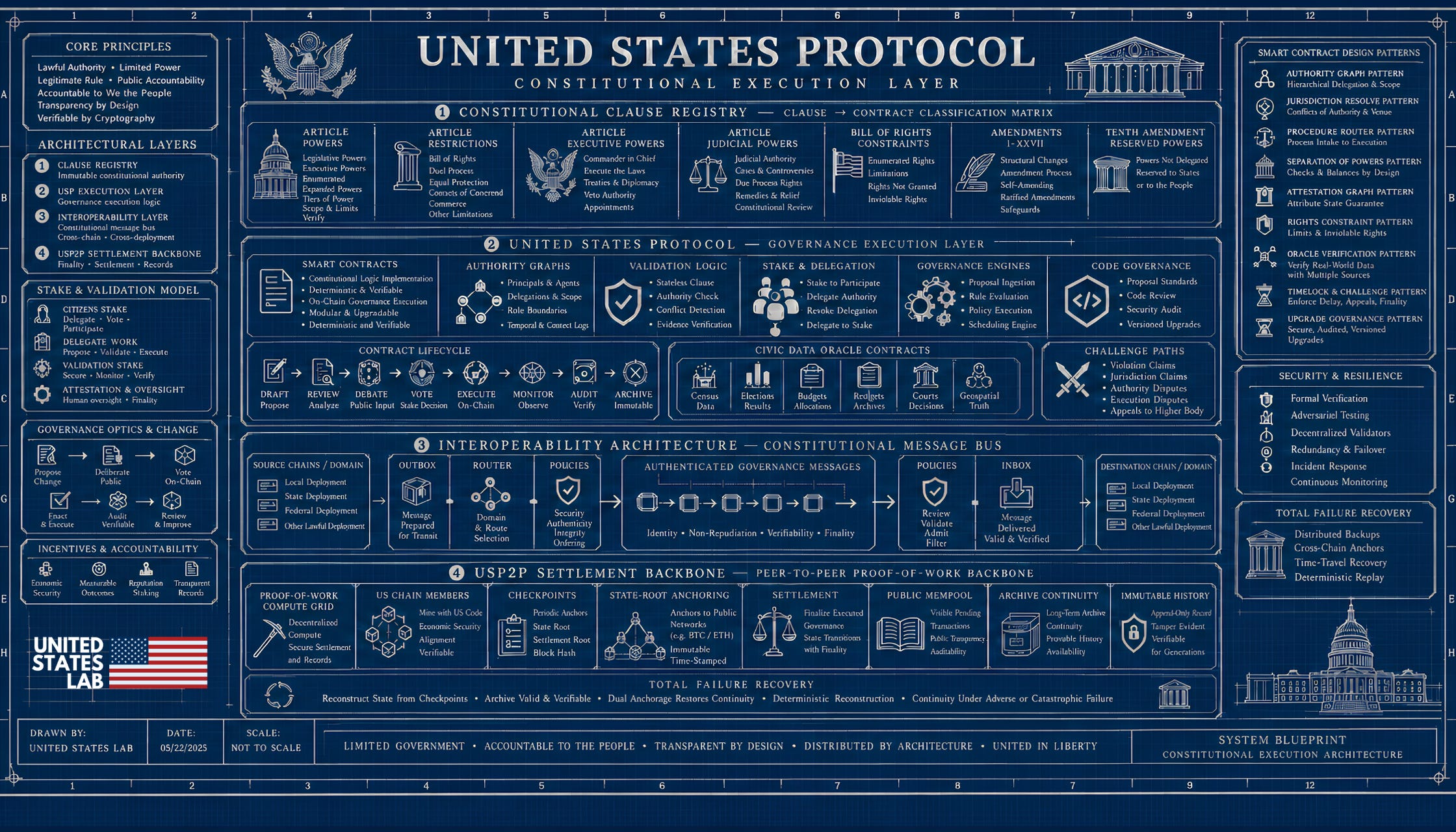
The United States Constitution can be understood as a governance specification. It defines offices, powers, procedures, limits, jurisdictions, elections, oaths, appropriations, courts, rights, federalism, amendment paths, and lawful transitions of public authority.
United States Protocol applies programmable governance infrastructure to this constitutional specification so that public power can become traceable, auditable, challengeable, and citizen-verifiable.
The blueprint developed by United States Lab describes a constitutional execution architecture. It addresses six core design problems:
Contract classification: how smart contracts are classified against constitutional clauses, powers, and constraints.
System separation: how United States Protocol remains distinct from USP2P.
Interoperability: how local, state, and federal deployments communicate while preserving lawful jurisdiction.
Civic data: how public records become verified, challenged, and oraclized for use inside governance logic.
Clause-Bound AI and SDK integration: how constitutional analysis, audit, explanation, and external application development operate through evidence-bound interfaces.
Code governance: how contracts are reviewed, upgraded, secured, and held accountable.
The core research question is direct: What smart contract architecture is required to implement a constitutional republic according to its own specification?
