


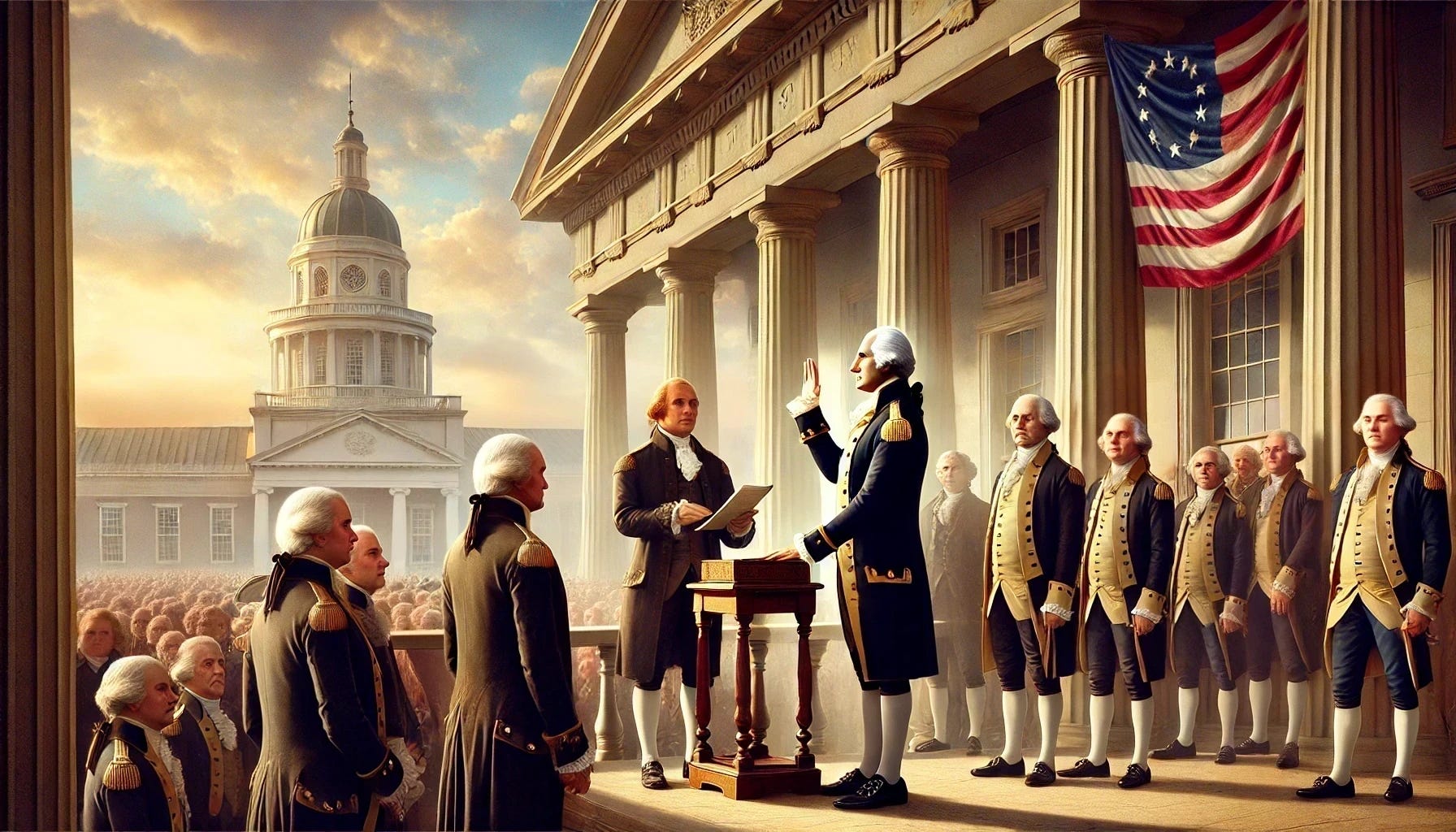
The Singular Nature of the Presidential Oath
It becomes necessary, in moments when the fabric of republican liberty is pressed and tested, to speak plainly and deliberately on the singular powers entrusted to the Chief Magistrate of the Union. The President bears a charge distinct among the officers of the Republic, for while all swear fidelity to our supreme charter, he alone is commanded, by solemn oath, to "preserve, protect, and defend the Constitution of the United States."
This language, carefully wrought by the Founders in Article II of the Constitution, invests the President with active duties of preservation, guardianship, and defense. Specified in Article II, Section 1, Clause 8, this oath underscores the Founders’ intent to vest the Executive with a singular mandate to safeguard the Republic’s supreme law.
Such a command elevates his role to one of resolute vigilance. It acknowledges that in a compound republic, surrounded by the vicissitudes of faction, ambition's reach, and the cunning devices which may erode liberty through subtle means, a singular protector must remain steadfast. As Alexander Hamilton argued in Federalist No. 70, the unity and energy of the Executive enable decisive action to safeguard the Republic, a principle embodied in the President’s unique oath. Historical precedent underscores this: Thomas Jefferson, for instance, refused to enforce the Sedition Act of 1798, deeming it a violation of the First Amendment, thus actively defending constitutional liberty against legislative overreach.
This guardianship mirrors the role of a Foundation steward in a blockchain ecosystem, which oversees a protocol’s integrity and vision. While the President operates as an execution layer validator, rejecting unconstitutional ‘transactions,’ his oath-driven duty to preserve the constitutional protocol’s foundational principles—liberty, checks and balances—casts him as a steward ensuring the Republic’s long-term fidelity to its charter, as Jefferson did by protecting free speech. The President’s cabinet, akin to advisors supporting a blockchain Foundation’s steward, provides counsel and coordination to advance his constitutional vision, yet lacks independent authority, remaining subordinate to his singular oath to preserve, protect, and defend.
The President’s oath stands in contrast to the broader oath required by Article VI, Clause 3, which binds Senators, Representatives, state legislators, and all executive and judicial officers of the United States and the states to “support this Constitution.” Unlike the President’s specific mandate to “preserve, protect, and defend,” the Article VI oath’s vague “support” lacks proactive verbs, implying a general fidelity rather than the President’s singular guardianship. In blockchain terms, these officials act as decentralized nodes upholding the constitutional protocol, while the President, as steward and operator, ensures its active defense, rejecting invalid ‘transactions’ that threaten liberty, a distinction rooted in the Founders’ design to vest the Executive with unique vigilance.
In modern terms, the President may be likened to the operator in a blockchain system tasked with safeguarding the protocol against invalid or malicious transactions. The President must validate the instructions passed down from the legislative consensus layer and subjected to judicial challenge layers, ensuring they do not breach constitutional rules.
Like an execution client enforcing only valid state transitions on a blockchain, the President stands ready to confront the overt aggressions of foreign enemies and the frequent and insidious dangers posed by domestic usurpation—whether through unconstitutional legislation, judicial encroachment, or corrupted process. His role is to preserve the integrity of the constitutional ledger, ensuring that every action committed is lawful and true to the founding protocol of the nation.
Abraham Lincoln’s suspension of habeas corpus during the Civil War exemplifies this role; he acted to preserve the Union’s constitutional framework, prioritizing his oath over strict adherence to judicial norms, a decision later debated but reflective of the Executive’s guardianship duty. Yet, beyond this operational role, the President acts as a Foundation steward, akin to a blockchain entity guiding the protocol’s evolution. Lincoln’s actions, like a steward coordinating a protocol’s defense against existential threats, ensured the Constitution’s principles endured, balancing immediate enforcement with the Republic’s long-term constitutional vision.
This stewardship contrasts with the Article VI oath, which requires other officials to “support” the Constitution without specifying execution or defense. For example, federal judges swear to “administer justice” faithfully (per 28 U.S.C. § 453, implementing Article VI), focusing on impartial adjudication, while legislators pledge to “bear true faith” (per 5 U.S.C. § 3331), emphasizing allegiance. These oaths, less prescriptive than the President’s, position other officials as supportive nodes in the constitutional network, lacking the Executive’s unique charge to actively preserve the ‘ledger’ against threats like Jefferson faced with the Sedition Act. In his daily duty, the President acts as validator and operator of execution, enforcing only valid constitutional transitions, while in times of crisis, he becomes the Foundation steward, guiding the protocol to defend against existential threats and preserve the charter of liberty, as Lincoln’s wartime actions demonstrate.
The President, in ordinary times, acts as validator and operator—enforcing only constitutional directives. Yet, in moments of crisis, when existential threats arise or the protocol is imperiled, he becomes the Foundation steward, guiding the Republic through uncertainty and defending its fundamental principles. In this dual role—validator in daily governance and steward in crisis—the President ensures that liberty endures.
The Distributed Powers of Government
In our system, power is intentionally dispersed across distinct departments, calibrated so that ambition may serve as a check upon ambition and no single hand may grasp unchecked authority. This design mirrors the architecture of a blockchain, where decentralized nodes participate to prevent any single entity from compromising the protocol. James Madison, in Federalist No. 51, articulated this balance, noting that the separation of powers ensures “ambition must be made to counteract ambition.”
The Legislature, assembled from the representatives of the people and the states, functions as the great consensus mechanism of the Republic. Much like validators in a blockchain network, these deliberative bodies propose and approve statutes intended to serve the public good and maintain lawful order. However, as in any consensus system, proposals may pass that, while procedurally sound, risk transgressing the higher law of the Constitution and placing liberties in jeopardy.
The Alien and Sedition Acts of 1798, for example, passed with procedural regularity but were widely criticized as unconstitutional for curbing free speech, prompting Jefferson’s defiance as a constitutional corrective. Legislators, bound by the Article VI oath to “support” the Constitution, participated in passing the Sedition Act, yet lacked the President’s oath-driven duty to actively defend against its unconstitutional impact. The Article VI oath’s flexibility—allowing varied statutory forms, such as Congress’ pledge to “bear true faith” (5 U.S.C. § 3331)—contrasts with the President’s specific mandate, highlighting his role as the final steward who, like a blockchain Foundation, rejects ‘invalid transactions’ to protect the protocol’s integrity.
The Judiciary, designed to be impartial and removed from the immediate voice of the people, serves as the tribunal of last resort for disputes in law and equity. It acts in the manner of an optimistic fraud proof layer, where claims are subject to challenge and invalid assertions are nullified. Through the measured process of judicial review, established in Marbury v. Madison (1803), judges weigh statutes and executive actions against the supreme charter, much like fraud proofs test transactions against network rules. Judges exercise reason and judgment in pursuit of justice, yet their rulings, like human-coded logic, may at times fall short of perfect fidelity to the higher constitutional protocol.
Andrew Jackson’s defiance of the Supreme Court in Worcester v. Georgia (1832), where he reportedly dismissed the Court’s ruling on the Cherokee, reflects the potential for judicial rulings to be challenged when perceived as straying from constitutional bounds, though such actions remain contentious. Jackson, reportedly dismissive of the Court’s decision, ultimately declined to enforce it, raising the profound constitutional question of Executive discretion.
Within this dynamic structure, the potential remains that both the Legislature and Judiciary, through ambition, error, or collusion, might uphold measures contrary to the foundational principles of liberty. To address this critical vulnerability, the constitutional framework entrusts a final layer of defense: the Executive.
The President—charged to preserve, protect, and defend—operates as the execution layer of government. Like the operator of a blockchain's execution client, the President ensures that only valid and constitutional commands are enforced, rejecting those that, though procedurally regular, would corrupt the integrity of the constitutional ledger. This role is indispensable, ensuring that unconstitutional directives do not transform into oppressive acts simply because they have cleared the earlier consensus and challenge layers. Jefferson’s refusal to enforce the Sedition Act illustrates this principle, as he acted to prevent an unconstitutional statute from polluting the constitutional ledger, prioritizing his oath over legislative consensus.
The President as Guardian of Execution
In such moments, the execution of the laws becomes the decisive point at which the preservation of liberty is secured or imperiled. Here, the President serves as preserver, protector, and defender of the constitutional order, positioned where judgment and discretion are essential duties of the highest magnitude. His oath calls him to more than fidelity to the written charter; it charges him with active responsibility—to preserve, guarding against decay and obsolescence; to protect, shielding against threats both foreign and domestic that endanger the nation's foundational principles; and to defend, taking decisive action to uphold constitutional governance when necessary.
Hamilton, in Federalist No. 78, noted the Executive’s veto power as a check on legislative excess, a principle that extends to enforcement discretion when laws or rulings threaten liberty. This guardianship transcends execution, positioning the President as a Foundation steward of the constitutional protocol. Like a blockchain Foundation ensuring a network’s principles—such as decentralization or security—the President’s proactive duty to ‘preserve, protect, and defend’ involves strategic oversight, rejecting laws or orders that, though procedurally valid, undermine the Republic’s core values, as Jefferson did in defending free speech against the Sedition Act.
Execution transcends the rote or mechanical. It is the moment where the written word becomes a living force upon the citizenry. In blockchain terms, this is the final settlement layer where valid transactions are confirmed and committed to the ledger. Similarly, a statute flawed in substance, though procedurally sound, may impose grave injury to liberty if carried into effect by the Executive. Just as a blockchain execution layer must reject invalid state transitions—even those appearing syntactically correct—the President must prevent enforcement of laws animated by unconstitutional aims. Judicial orders, though cloaked in authority, are akin to fraud proofs that require validation; they remain subject to the supreme constitutional protocol. For instance, Lincoln’s wartime actions reflect a President rejecting “invalid transitions” to preserve the constitutional order, though such discretion must be balanced against risks of overreach, the only recourse being impeachment.
Lincoln prioritized the preservation of the Union and national survival above strict procedural adherence, invoking his stewardship duty to maintain constitutional order under extreme duress, a decision that underscores his role as both validator and steward. In these moments, the President’s role as a Foundation steward shines, as he ensures the constitutional ledger’s integrity, much like a Foundation coordinating a blockchain’s response to a critical vulnerability, prioritizing the protocol’s long-term fidelity over immediate compliance. As validator and operator, the President enforces constitutional fidelity in daily governance, while as Foundation steward, he guides the Republic through crises, ensuring the protocol’s principles endure, as seen in Lincoln’s decisive actions.
Thus, the President, as executor of law, serves as conscientious guardian and protocol operator. His duty requires unwavering scrutiny of every proposed state transition. Each command, whether arising from statute or court, must align precisely with the supreme law. Where harmony exists, execution proceeds with vigor and commits to the constitutional ledger; where discord emerges, the President must exercise his solemn charge to abstain from action, ensuring invalid operations do not pollute the chain of lawful governance.
Beyond merely abstaining, the President must actively prevent unconstitutional enforcement from propagating through lawful execution, securing the constitutional ledger with resolute governance. In this responsibility, he fulfills his vital role within the constitutional architecture, ensuring that no measure, however procedurally proper, undermines the liberties secured by the people. This principle echoes Madison’s vision in Federalist No. 51, where the Executive’s role complements the checks and balances that safeguard liberty.
The Perils of Lawfare and Subversion
Consider further the subtle and insidious artifice of lawfare—wherein statute, cloaked in the ordinary and seemingly legitimate forms of law, is wielded with precision and cunning to achieve ends alien to the constitutional spirit and harmful to the liberties of the people. Lawfare advances quietly and deliberately through the corridors of legal process, adorning itself in the robes of justice while concealing its improper purpose. Much like a sophisticated smart contract exploit, it leverages trusted code paths and procedural mechanisms to achieve results unintended by the protocol's framers. It exploits the trust placed in legislative enactments and judicial rulings, turning instruments of governance into tools of undue control. Through vague, overly broad, or ingeniously crafted statutes, as well as interpretations by authorities extending beyond their rightful domain, coercion may emerge and influence the affairs of free citizens.
The Sedition Act of 1798 serves as a historical example of lawfare, passed under the guise of national security but used to silence political dissent, prompting Jefferson’s principled resistance as a defense of constitutional liberty. Enacted during the Quasi-War with France, the Act aimed to curb writings that could incite insurrection or aid foreign enemies, a legitimate concern for Federalists fearing domestic instability. However, its enforcement against Jeffersonian critics revealed its use to suppress political speech, violating the First Amendment in Jefferson’s view.
While the Sedition Act expired in 1801, the Alien Enemies Act from the same legislative package remains in force, addressing enemy combatant threats, though distinct from the Sedition Act’s speech restrictions. Jefferson’s refusal to enforce the Sedition Act reflects his role as a constitutional operator, rejecting an ‘invalid transaction’ that, despite its security rationale, undermined liberty. As a Foundation steward, the President’s role extends beyond operational validation to strategic oversight, ensuring that lawfare, like a blockchain exploit, does not erode the constitutional protocol’s core principles, much as a Foundation might reject a protocol change that compromises decentralization or security.
In such a climate, the President, as chief guardian of constitutional execution, must remain in a state of vigilant discernment. His solemn oath, pronounced before the nation with sacred gravity, binds him to uphold the higher substance of constitutional fidelity. He must examine each law and order as an operator examines proposed state transitions, ensuring their operation preserves the natural rights of the people and remains true to the fundamental structure of the republic.
The President’s charge is to guarantee that enforcement, which gives breath and force to the law, sustains lawful order without becoming oppressive or introducing invalid operations into the constitutional ledger. Jefferson’s actions against the Sedition Act exemplify this vigilance, as he rejected a procedurally valid law to protect the First Amendment, acting as a blockchain operator rejecting a malicious transaction. As a Foundation steward, the President’s role extends beyond operational validation to strategic oversight, ensuring that lawfare, like a blockchain exploit, does not erode the constitutional protocol’s core principles, much as a Foundation might reject a protocol change that compromises decentralization or security.
Thus, when measures emerge that bear the form of law yet diverge from its noble purpose, the President is guided by duty and honor to interpose his judgment. Just as a validator node must reject invalid transactions or malicious contract calls that would compromise network integrity, so too must the President withhold enforcement when execution would compromise his oath.
Far from passive restraint, the President must actively secure the constitutional order by preventing invalid directives from undermining lawful governance, governing execution with steadfast fidelity to the supreme law. By doing so, he serves boldly as the constitutional sentinel. In this role, he becomes the living shield of the republic, preserving it from the subtle corruption that lawfare seeks to introduce. His station calls for steady and courageous action to uphold constitutional governance, securing for posterity the blessings of liberty entrusted to his watch.
This duty aligns with Hamilton’s Federalist No. 70 vision of an energetic Executive, capable of decisive action to protect the Republic’s foundational principles. In daily governance, the President validates constitutional transitions as an execution operator; in moments of lawfare or crisis, he assumes the Foundation steward’s mantle, guiding the protocol to safeguard liberty, as Jefferson’s principled resistance exemplifies.
The President as Final Constitutional Steward
Even in the most perilous hour, when all other safeguards yield—when the Legislature, swayed by faction or impelled by haste, crafts measures that transgress constitutional bounds, and when the Judiciary, entrusted to be the arbiter of constitutional fidelity, falters in its duty—the President remains steadfast. He assumes the role of the final operator of the execution layer of government, akin to a node responsible for confirming valid state transitions on a blockchain.
In this station, he bears a singular and weighty charge: to withhold the power of enforcement from unconstitutional commands, thereby preventing invalid or malicious instructions from becoming finalized in the constitutional ledger. More than withholding, the President actively governs execution to maintain constitutional fidelity, ensuring no invalid command propagates through the Republic’s lawful order. Marbury v. Madison (1803) established judicial review, but the President’s oath implies co-equal authority to interpret the Constitution, as seen in Jefferson’s Sedition Act stance, ensuring that no branch monopolizes constitutional fidelity.
This role as final steward aligns with a blockchain Foundation’s duty to act decisively in crises, such as coordinating a hard fork to reverse a protocol-threatening hack. The President, as a Foundation-like steward, ensures the constitutional protocol’s integrity, rejecting invalid ‘transactions’ to preserve liberty, as Lincoln did during the Civil War by prioritizing the Union’s survival.
He serves as the decisive barrier against the erosion of liberty that may arise through ordinary forms of law cloaked in procedural regularity—much like a blockchain validator rejecting transactions that, though formatted correctly, violate protocol rules. In this critical role, the President exercises solemn judgment and discernment, ensuring that each directive subjected to his execution bears the true imprint of constitutional legitimacy before being committed into the fabric of national governance.
Jackson’s reported defiance in Worcester v. Georgia reflects this principle, as he prioritized his view of constitutional duty over a judicial ruling, illustrating the Executive’s role as a final check. Jackson, reportedly dismissive of the Court’s decision, ultimately declined to enforce it, raising the profound constitutional question of Executive discretion.
Thus, he stands as the vigilant constitutional steward and operator, preserving the integrity of republican governance much as a blockchain's honest nodes secure network consensus. His duty continues until the sovereign people, acting through their rightful and decentralized institutions, restore and perfect the constitutional order and reaffirm the primacy of lawful governance in their collective ledger of liberty. This role underscores Madison’s Federalist No. 51 design, where the Executive’s vigilance complements the people’s sovereignty to maintain the Republic’s constitutional balance, and brings us to the President’s most solemn charge: his Sacred Trust.
The President's Sacred Trust
The President's oath is singular in scope and significance, established with care by the Founders to create a role that embodies more than passive obedience to legislative or judicial authority. This solemn commitment carries a sacred duty of active discernment and principled guardianship. The President, as constitutional operator, functions much like a blockchain validator charged with the final approval of state transitions. Every action of the Executive must be validated against the supreme law, ensuring constitutional integrity. His loyalty to the Constitution calls for firm resolve against unconstitutional encroachments, especially those masked in procedural legitimacy. Lincoln’s wartime decisions reflect this resolve, as he navigated constitutional tensions to preserve the Union, guided by his oath.
Lincoln prioritized the preservation of the Union and national survival above strict procedural adherence, invoking his stewardship duty to maintain constitutional order under extreme duress. Yet, this role transcends operational validation, casting the President as a Foundation steward of the constitutional protocol. Like a blockchain Foundation safeguarding a network’s vision, the President ensures the Republic’s foundational principles endure, balancing enforcement duties with strategic oversight to secure liberty for posterity.
This singular duty contrasts sharply with the Article VI oath, which binds other officials to “support” the Constitution without the President’s proactive mandate. While federal and state officers, including judges and legislators, swear varied oaths to uphold the Constitution—such as judges’ pledge to “administer justice impartially” (28 U.S.C. § 453) or legislators’ to “bear true faith” (5 U.S.C. § 3331)—these lack the President’s specific charge to actively defend the constitutional ‘ledger.’ In blockchain terms, these officials serve as nodes maintaining network consensus, while the President, as steward and operator, bears the unique burden of rejecting ‘invalid transactions,’ as Lincoln did, to preserve the Republic’s core principles.
In fulfilling this role, the President stands in profound service to the Republic. He does not rule through arbitrary power. Instead, he is the devoted steward of the Constitution—guided not by fleeting desires or factional demands, but by the enduring principles that govern all branches of government. Like a network node dedicated to protocol integrity, the President must consistently uphold constitutional order despite pressures or attempted exploits. Through his faithful adherence, the rights of the people remain secure. The accountability mechanisms of elections and impeachment, as outlined in Article II, Section 4, ensure that the President’s actions remain tethered to the people’s will, reinforcing his role as steward rather than autocrat.
As long as the Chief Magistrate fulfills this sacred trust with clarity and fortitude—just as honest blockchain operators preserve network legitimacy by recording only valid transactions—the Republic endures. Liberty finds its strongest defender not through force, but through the vigilant heart and discerning mind of the Executive, who remains steadfast in his sworn duty to preserve, protect, and defend the Constitution of the United States. This enduring commitment, rooted in the Founders’ vision and exemplified by Presidents like Jefferson and Lincoln, ensures that the constitutional ledger remains a faithful record of the people’s liberty.
In this sacred trust, the President embodies the role of a Foundation steward, guiding the constitutional protocol through challenges to secure the Republic’s vision of ordered liberty, as a blockchain Foundation ensures a network’s principles withstand threats and time. In every era, whether validating the lawful daily execution of constitutional commands or stewarding the Republic through threats that demand principled deviation to preserve its essence, the President remains the active defender of the protocol—ensuring that liberty, like a decentralized network bound to first principles, survives and flourishes.
At United States Lab, we are implementing the United States Constitution's compound republic governance model in web3. If you are interested in this research, please follow our R&D work.