


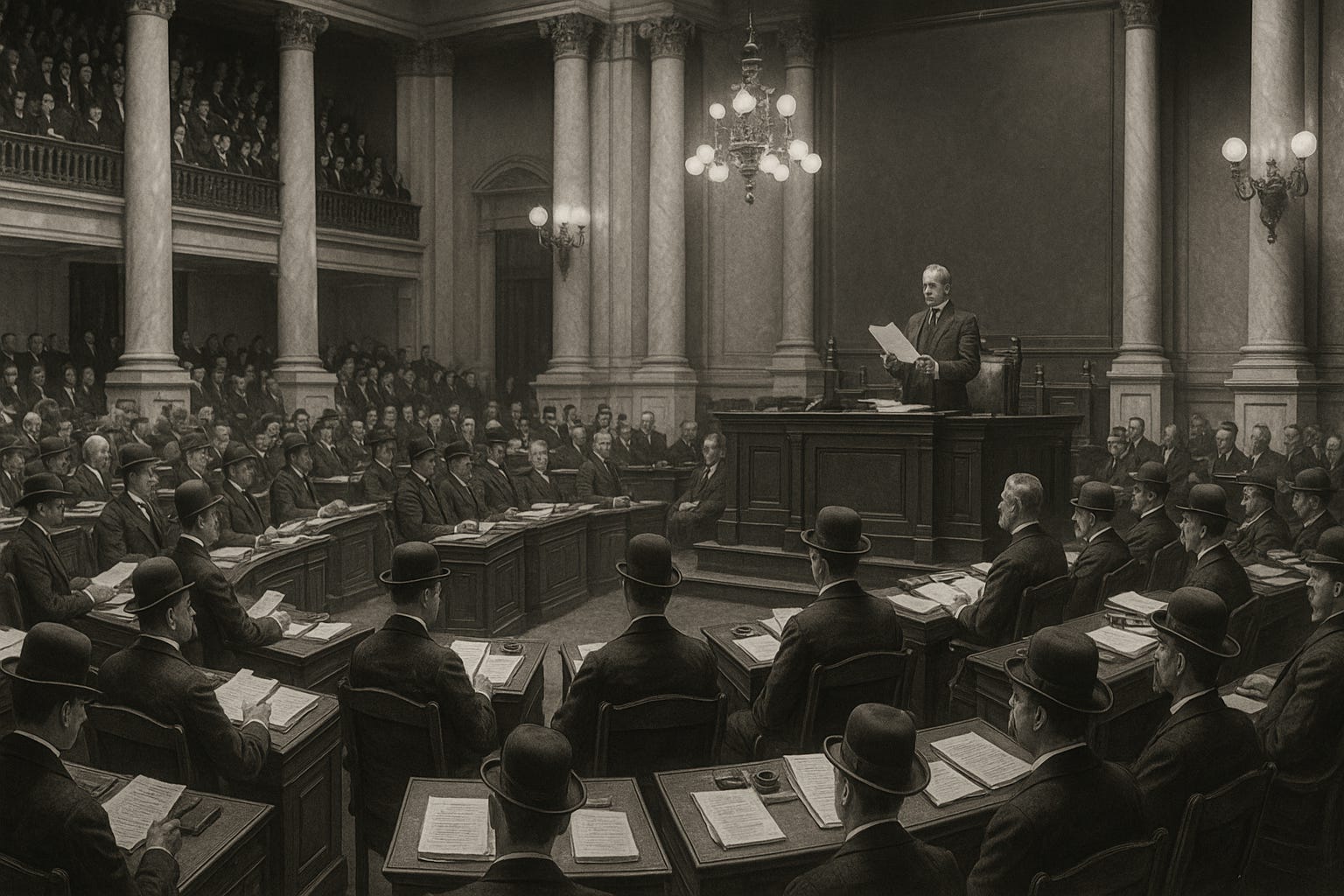
The objective is to re‑establish, in practical effect, the pre‑1913 incentive structure in which State legislatures select U.S. Senators. Rather than waiting on change that may never come, United States Lab’s approach uses citizen signaling, verifiable credentials, candidate covenants, and party/legislative procedures to recreate the behavior of the original system. The 13 United States Protocol governance primitives provide the guardrails that keep the process predictable, auditable, and resistant to capture. Here’s how it happens…
A State’s major parties adopt caucus‑bound nomination rules
Legislative caucuses credential their selections
Citizens can verify compliance
Elected Senators operate under continuing instruction from their State legislature with public justification for deviations
This is an incentives‑first restoration. By aligning political incentives to caucus‑based selection and making those alignments verifiable, we produce Madisonian compatible outcomes without overstepping current governance or law.
Citizen Identity & Sybil Resistance
A reliable signal requires a reliable identity layer. United States Protocol’s identity layer focuses on uniqueness, eligibility, and residency while preserving privacy. The goal is simple—one eligible State citizen, one credentialed voice, refreshed at appropriate epochs.
Citizen Credential: Each citizen mints a non‑transferable, proof‑of‑eligibility credential bound to their State.
Zero‑Knowledge Proofs (ZKPs): Citizens prove uniqueness, residency, and eligibility without revealing PII.
Epoch Renewal: Credentials refresh each election cycle to reflect current residency and eligibility.
This layer blocks Sybil inflation, blocks cross‑state interference, and ensures the citizen‑aggregate truly reflects the State polity. With identity and eligibility settled cryptographically, downstream signals and challenges can be trusted as representative of the State’s citizens.
Citizen Signaling
Instead of casting direct votes for Senator in this protocol, citizens instruct their State legislators on the method of selecting nominees and the rules that should govern the caucus. These instructions become the political mandate that parties and legislators either adopt or visibly resist.
Primary Signal: "Legislative caucus should select Senate nominees."
Secondary Signals: Preferences for quorum thresholds (i.e., 3/5th, 2/3th), transparency levels, runoff rules, and challenge procedures.
Delegated Stake: Citizens allocate governance stake to State legislative candidates who pledge to uphold caucus‑selection rules.
Three dashboards translate signals into actionable metrics:
Restore-Pre-17 Index: Percentage of verified citizens in a State demanding legislative caucus selection.
Legislative Mandate Map: Visualization of pledge‑backed candidates by district.
Caucus Rule Vector: Aggregated preferences for quorum, thresholds, runoffs, transparency, and challenge windows.
These metrics transform diffuse public will into concrete leverage legislators and parties cannot ignore, while giving citizens a continuous readout of momentum.
Party & Legislature Adoption
Signals are leverage, and rules are where leverage converts to behavior. By upgrading party rules and establishing legislative resolutions, States can restore caucus‑bound nominations within existing legal frameworks.
Party Rule Upgrade
State parties adopt binding rules: Senate nominees come only from legislative caucus decisions.
Rules codify quorum thresholds, voting procedures, and challenge periods.
Candidate Covenant Credential
Senate candidates sign a Mandate Covenant credential, pledging to accept caucus outcomes.
Breaches (i.e., repudiating caucus results) trigger citizen challenges, reputational slashing, and removal from party support.
Legislative Resolution of Instruction
Legislatures adopt standing resolutions to conduct caucuses at fixed epochs and transmit results to parties.
Interstate Signaling Compact
States voluntarily align procedures, issuing standardized Caucus Credential Schemas for interoperability.
Parties control ballot access and brand power; caucus‑bound party rules make the legislative selection determinative. Candidate covenants align personal incentives with the caucus; legislative resolutions institutionalize cadence and procedure. Adoption at the party and legislature levels converts citizen intent into a repeatable, enforceable process that operates every cycle.
Credential Graph
Legitimacy flows from verifiable process. United States Protocol models every role and every material action as a credentialed event, producing an audit‑ready graph that can be checked by citizens and the press. This credential graph functions much like a double-entry accounting system, where every action has a counter-record, ensuring transparency and public verifiability.
Every participant carries verifiable credentials (VCs):
Legislators: eligibility, chamber, quorum participation records.
Caucus Sessions: quorum proofs, ZK vote tallies, final outcome hashes.
Candidates: covenant pledges, disclosures, and nominee credentials once selected.
Because each step emits a credential, the chain of custody from citizen mandate to ballot line can be traced and, if necessary, challenged. The credential graph is the backbone of transparency. It allows the public to inspect not just outcomes, but the integrity of the path to those outcomes.
Execution Flow
The execution sequence standardizes how nominations progress from signaling to ballot filing and then to post‑election accountability. Predictability is a safety feature; attackers exploit ambiguity, not routine.
Citizen Signaling Locks: Instructions collected and published.
Legislative Caucus: Both chambers (or joint session) conduct threshold‑based voting.
Challenge Period: Citizens may submit ZK‑backed challenges to quorum failures, bribery proofs, or rule violations.
Adjudication & Reversibility: Juror pools of citizens (via sortition) resolve disputes and, if necessary, roll back results.
Nominee Credential Issued: Caucus outcome logged; candidate receives verifiable nominee status.
General Election: Ballot includes verifiable caucus badge.
Instruction Ledger: After election, Senators maintain a public ledger of alignment with legislative resolutions; deviations require justification.
Each phase exposes attack points to scrutiny and provides an orderly corrective if a fault is proven. With clear stages, transparent artifacts, and credible remedies, the process becomes both robust and teachable.
Mapping to the 13 United States Protocol Governance Primitives
The 13 governance primitives are the protocol’s constitutional muscle. Each primitive contributes a safety, liveness, or legitimacy guarantee, and together they compose a complete governance circuit.
Bicameral Filtering — Both chambers required to confirm nominees.
Veto Mechanisms — Caucus vetoes candidates failing disclosure.
Impeachment & Removal — Officials falsifying credentials barred from future caucuses.
Statute Limits & Delays — Cooling‑off periods between caucus rounds.
Adjudication & Reversibility — Rollbacks enabled by citizen‑proven faults.
Juror Pools / Sortition — Citizen juries resolve challenges.
Threshold Voting — Supermajority rules applied in caucus.
Proxy & Delegation — Citizens delegate stake to legislative candidates.
Challenge Periods — Fixed windows for contesting results.
Separation of Powers — Judiciary excluded; process resides in legislative/party domain.
Citizen Challenge — Any citizen may prove a violation.
Epoch Renewal — Credentials reset each legislative cycle.
ZK Participation — Privacy‑preserving signals and vote proofs.
No single primitive carries the load; their interplay restores the incentive structure that made the original Senate resilient. The primitives act as fail‑safes and guardrails, preserving legitimacy under pressure without sacrificing decisiveness.
Anti‑Capture Measures
Adversaries target identity, quorum, and information asymmetry. The protocol anticipates these vectors and neutralizes them with layered, pre‑committed defenses.
Residency Proofs: Prevent non‑State actors from influencing outcomes.
One Credential = One Citizen: Stops Sybil infiltration.
Covenant Breach Enforcement: Breaches logged and slashed; candidates lose reputational capital.
Fork Safety: If one party reneges, alternatives adopt caucus rules and inherit citizen momentum.
These controls make it costly to cheat and easy to coordinate against defectors. The more these defenses are exercised and publicized, the more deterrence they create for future cycles.
Citizen Adoption
Adoption benefits from staged commitment: publish models, pilot signals, harden procedures, then scale. Each phase produces public artifacts that compound credibility:
Publish model party rules and covenant schemas
Pilot citizen signaling dashboards in States
State parties adopt caucus rules
Credential issuance for candidates and legislators
First caucus‑bound nominations executed
Challenge system tested in production
Multi‑State adoption
Interstate credential schema interoperability
Early adopters generate proof‑points; parties and donors respond to a visible mandate and process integrity. A predictable calendar of public artifacts (rules adopted, caucuses credentialed, challenges resolved) converts theory into institutional habit.
How We Achieve Success
Clear metrics steer effort and let citizens judge progress without spin.
≥60% Restore-Pre-17 Index in pilot States
Major parties in at least one State adopt caucus rules
Challenge/reversibility functions validated
Senators’ instruction ledgers demonstrate high compliance
These indicators measure mandate, institutional buy‑in, procedural integrity, and post‑election accountability. When these gauges move together, you get a durable change in incentives, not a one‑off win.
Strategic Significance
The Senate’s original design was a structural safeguard for federalism and the compound republic. Recreating its incentive dynamics through protocol aligns contemporary politics with that safeguard.
By shifting selection upstream to the legislature (via party rules, candidate covenants, and citizen‑verified caucuses) we restore the feedback loop that tied national policy to State interests.
This is constitutional federalism implemented as an operating routine—measurable, inspectable, and resilient under competitive pressure.
Amendment Path — Coordinated Repeal of the 17th Amendment
Once citizens control the signaling layer and parties operate under caucus‑bound rules, the polity gains the practical levers to pursue formal constitutional alignment. The same coordination engine can be directed toward a repeal effort. Citizens use signaling to instruct their State legislators to initiate and support an Article V pathway to propose an amendment repealing the 17th Amendment. Practically, this manifests as:
State‑level applications for a convention with a focused call (repeal or restore legislature‑selection), backed by published mandate metrics (Restore-Pre-17 Index, Legislative Mandate Map).
Model resolutions and credential schemas for legislative applications, ensuring multi‑State uniformity and auditability.
Interstate dashboards that show which States have submitted applications, the text used, and the verification status of each step.
Legislators respond to visible, verifiable mandate. A high Restore-Pre-17 Index, coupled with pledged majorities in State houses and senates, establishes political inevitability. By the time a convention or congressional proposal is feasible, the culture and procedures will already operate on caucus‑selection. Formal repeal becomes the legal seal on a reality that citizens already built.
Maintaining the Dynamics Post‑Repeal
After repeal and restoration of the original design, the temptation to drift returns unless incentives and verification persist. United States Protocol continues to anchor behavior to the principles that made the system robust.
Caucus Credentials remain standard: quorum, thresholds, challenges, and outcome hashes continue every cycle.
Instruction Ledgers keep Senators aligned with State legislative resolutions, with public justification for deviations.
Epoch Renewal ensures validator sets (legislatures) reflect current elections and retire stale credentials.
Citizen Challenge and Juror Pools remain available to correct process failures quickly and visibly.
With the primitives embedded in routine practice, States preserve the selection dynamic through transparency, challengeability, and periodic renewal. The amendment restores the text; the protocol preserves the incentives. Together, they lock in a Madisonian model Senate for the long run.
By equipping citizens with verifiable tools of signaling, credentialing, and challenge, we restore the very accountability that was stripped away in 1913. The attack vector that shifted Senate selection from State legislatures to direct election, and enabled the unchecked passage of centralizing measures like the Federal Reserve Act, can be closed by returning power to its rightful stewards—the people acting through their States.
In this framework, citizens are active governors, armed with mechanisms that make capture costly, transparency inevitable, and fidelity to Madison’s design enforceable. It is through these tools that the compound republic is not only defended, but renewed.
At United States Lab, we are implementing the United States Constitution's compound republic governance model in web3. If you are interested in this research, please follow our R&D work.