


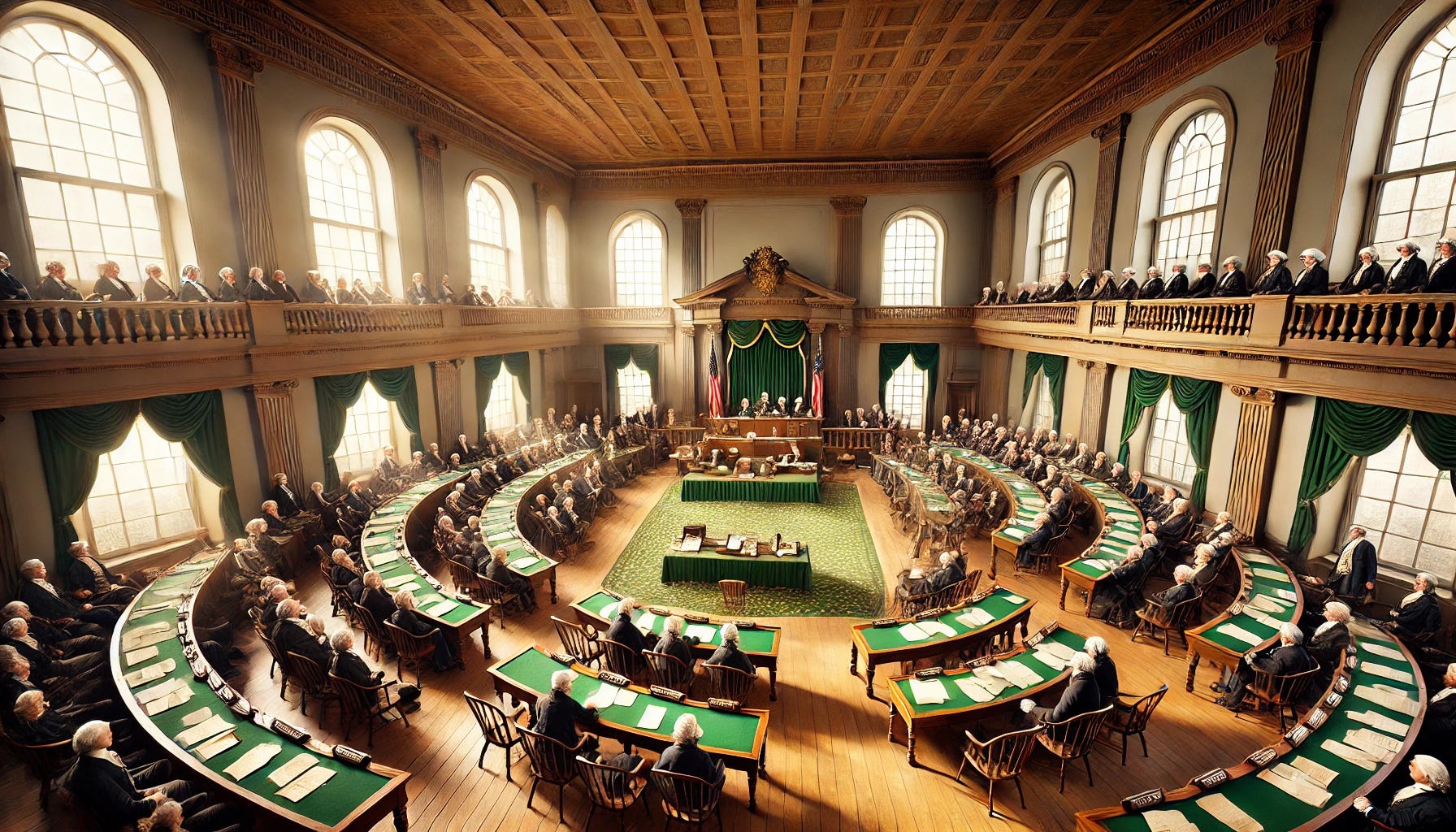
In the founding era of the United States, the public gallery stood as a vibrant and indispensable expression of government by consent. It offered a direct, unmediated channel between the people and their representatives, where citizens could see the expressions on legislators’ faces, hear the tone and cadence of every argument, and follow the exact moment a vote was cast. Positioned above the chamber floor, it symbolically placed the citizenry in a role of oversight and guardianship over the republic’s decision-makers. The gallery functioned as both a civic theater and a constitutional safeguard, making public presence an inherent part of governance.
United States Lab advances this founding-era innovation into the 21st century with precision and permanence. No longer confined to timbered railings and carved balconies, the gallery becomes an immutable, cryptographically verifiable layer of civic infrastructure. Integrated natively into the governance protocol, this digital public gallery enables citizens to observe in real time, engage with candidates and representatives through authenticated channels, and record these exchanges as unalterable entries on the public ledger. This continuous and interactive presence transforms the gallery into a living instrument of transparency, citizen influence, and enduring accountability that operates across and between election cycles.
The Historical Public Gallery
The concept of the public gallery originates in the British parliamentary tradition, where citizens were permitted to be present in the House of Commons, witnessing firsthand the debates, speeches, and procedures that shaped law and policy. This openness was carried across the Atlantic and given renewed force by the American founders, who institutionalized the practice at both the state and federal levels. They designed legislative chambers with dedicated galleries that were deliberately accessible to the public, embedding the principle of constant citizen oversight into the architecture of governance.
Open Access
Citizens could freely enter and position themselves in spaces designed for their use, affirming that the people possess a perpetual right to oversee the activities of their government. These galleries often operated on a first-come basis, encouraging a broad cross-section of society to witness the proceedings.
Architectural Prominence
The placement of these galleries was intentional: elevated seating in Independence Hall, the Massachusetts State House, and early congressional buildings allowed citizens to look down upon the floor, a powerful symbol that ultimate political authority resides with the people. This physical elevation reflected the constitutional reality of popular sovereignty.
Civic Education
Attending sessions in person offered citizens a masterclass in governance. They could study procedural motions, follow the structuring of debates, and watch coalitions form and dissolve. Observers left not only more informed but also more capable of evaluating their representatives’ performance.
Behavioral Accountability
Legislators were conscious of being in the public eye. Every statement, gesture, and vote was delivered with the knowledge that constituents could be in the gallery that very day. This presence helped to temper rhetoric, encourage preparedness, and reinforce decorum.
James Madison, in Federalist No. 51, underscored the lasting significance of this arrangement:
“A dependence on the people is, no doubt, the primary control on the government.”
The gallery thus served as a constant, physical manifestation of the principle that legitimate authority is sustained through the active consent and direct oversight of the governed.
The Public Gallery in the Polylithic Governance Model
In the Polylithic Governance framework, the public gallery is not merely a symbolic space but a fully realized governance primitive—an active, secure, and continuously accessible digital venue where citizens can both observe and directly influence governance. It functions as an integrated execution layer within the protocol stack, ensuring that citizen oversight is inseparable from the processes that shape political outcomes.
Visibility
Every candidate for office is permanently registered in the gallery’s public ledger, establishing a baseline of transparency for the entire electoral process.
All claims, qualifications, and policy positions are converted into cryptographically verifiable credentials, making them provable at any time.
Citizens can access these records in their original, unaltered form, free from editorial filtering or partisan interpretation, enabling independent judgment.
Interaction
Citizens may actively participate by signaling preferences, submitting questions, proposing issues for discussion, and initiating formal challenges against disputed claims.
Candidate responses, clarifications, and commitments are permanently recorded, building a durable, immutable record of public engagement and accountability.
This continuous exchange creates an evolving historical dataset of discourse, which can be analyzed for patterns in responsiveness, integrity, and issue prioritization.
Electoral Leverage
The gallery serves as the definitive arena where political legitimacy is established and maintained, becoming central to every serious campaign strategy.
Sustained, authentic engagement within the gallery is essential for candidates to demonstrate credibility and remain electorally viable.
The gallery operates as a competitive marketplace of trust, where the currency is verifiable proof of qualification, performance, and commitment to constituents.
Governance by Consent in the Digital Age
In the 18th century, the public gallery occupied a physical balcony above the legislative chamber, giving citizens a commanding view of the proceedings and symbolizing their role as ultimate overseers of political authority. In the 21st century, United States Lab’s public gallery elevates this concept into a global, networked balcony—an always-accessible civic vantage point anchored in cryptographic trust. Here, physical presence is replaced by verifiable digital presence, enabling millions of citizens to watch, interact, and record governance activity with the same weight and authenticity as those who once sat above the floor in Independence Hall.
Governance Mechanisms Embedded in the USL Public Gallery
Bicameral Filtering — Citizens act as the first and most essential filter for candidate legitimacy, with representatives serving as a secondary layer of refinement and review.
ZK Participation / Privacy Shielding — Every citizen can engage fully in the process while protecting personal identity, leveraging zero-knowledge proofs to verify eligibility without revealing sensitive details.
Challenge Periods — Clearly defined windows allow any citizen or authorized validator to present evidence and initiate formal disputes over candidate claims or credentials.
Verifiable Credentials — Each candidate statement, qualification, and policy position is anchored as an immutable proof on the public ledger, ensuring it can be independently validated and audited at any time.
The gallery functions as a constitutional subsystem in which visibility, authenticated participation, and permanent recordkeeping directly shape governance outcomes.
A Peaceful and Effective Restoration Strategy
The Polylithic Governance public gallery operationalizes the principle of political gravity by transforming concentrated public attention into a decisive force within the governance process. When the citizenry unites within one secure, verifiable civic venue, the venue itself becomes the central arena for political legitimacy. Candidates are drawn into this environment because it is where trust is earned, where public opinion forms in real time, and where measurable proof of engagement becomes an indispensable asset for electoral success. Inside this space, every participant operates under uniform rules of transparency, proof, and accountability that apply without exception.
By embedding these dynamics into the governance protocol, the system renews the Founders’ intended equilibrium with greater precision and permanence:
Representatives operate in a continuous state of reliance on the people, both in visible actions and in the structural mechanics of their authority.
Citizens hold an uninterrupted and empowered role in governance oversight, influencing discourse, policy direction, and candidate viability year-round.
The platform’s architecture, anchored to Proof-of-Work (i.e., Bitcoin) for publicly verifiable security guarantees, maintains resilience against power consolidation and safeguards the integrity of institutional processes.
A Platform for the United States & Other Decentralized Republics
The Polylithic Governance public gallery is designed with intentional alignment to the American constitutional framework, serving as a living extension of the Founders’ vision. It fortifies the bond between citizens and their representatives across all levels—local, state, and federal—by creating a unified, verifiable, and interactive forum for governance engagement. Grounded in the original architecture of the compound republic, it:
Reinforces checks and balances envisioned by Madison by ensuring that every branch and level of government remains answerable to the people through verifiable, real-time interaction.
Ensures transparency in candidate selection, qualification, and ongoing performance by placing all credentials, claims, and engagements into a public ledger that is cryptographically secured and permanently auditable.
Establishes a continuous, immutable record of governance in action, enabling citizens and historians alike to trace decision-making and accountability over time.
This system revives and modernizes the founding-era principle that the people are the ultimate source of political authority. It equips every citizen with a direct, technology-enabled role in observing, guiding, and influencing their government’s operations, effectively making public oversight an integrated function of the republic’s day-to-day governance.
Legacy Carried Forward: The Ever-Present Eye of the Republic
The Founders embedded the gallery into the physical chambers of government as a perpetual emblem of the people's presence and authority. United States Lab extends this principle into the digital age by embedding it within the governance protocol itself, where it operates as a living, technical safeguard. In this form, the oversight of the people is continuous, cryptographically verifiable, and woven directly into the operational logic of the republic, ensuring that the public’s role is inseparable from the processes of decision-making, validation, and execution that define constitutional governance.
At United States Lab, we are implementing the United States Constitution's compound republic governance model in web3. If you are interested in this research, please follow our R&D work.