


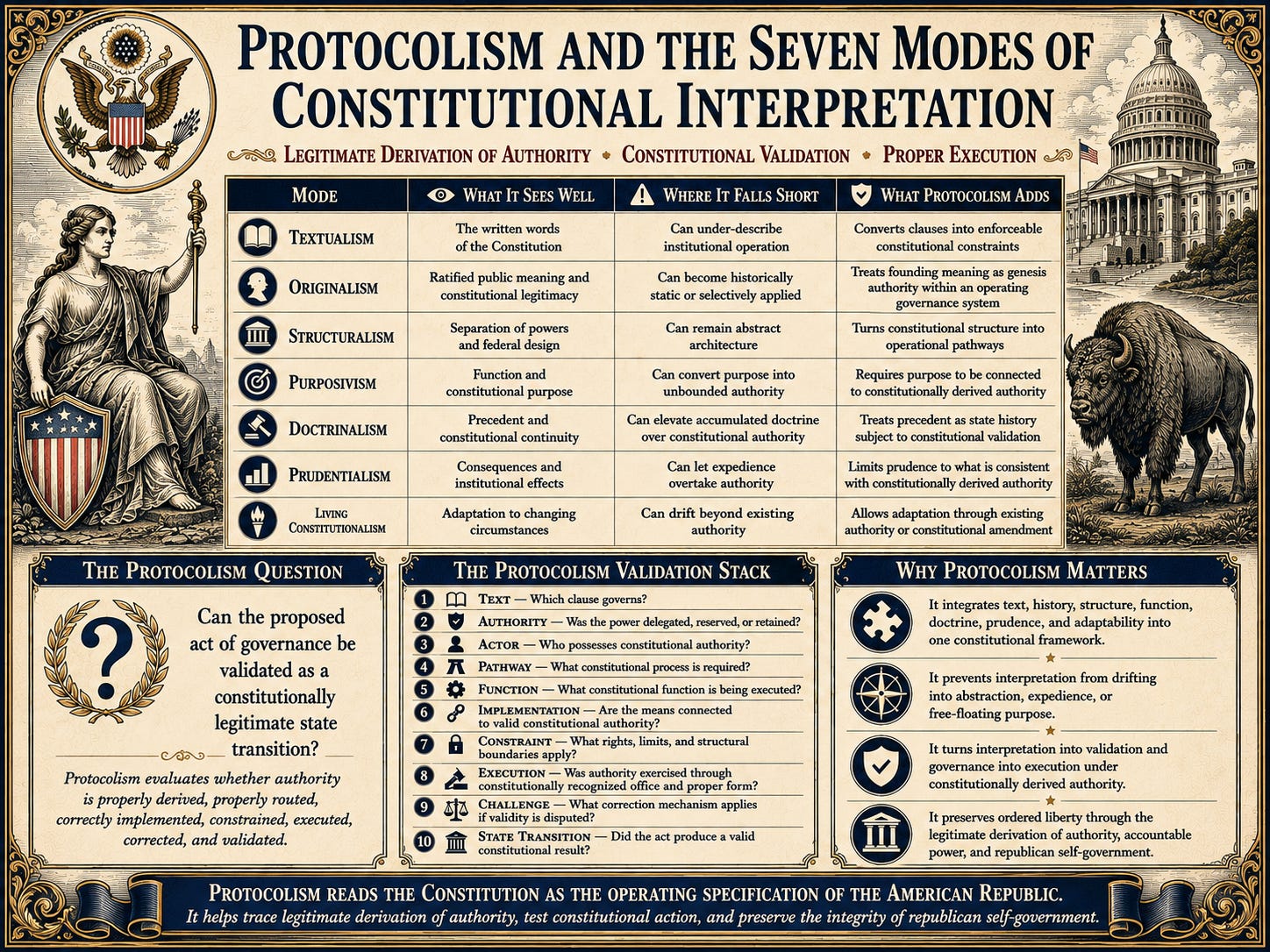
American constitutional theory is often presented through several major schools of interpretation. Textualists begin with the words. Originalists begin with ratified public meaning. Structuralists examine constitutional architecture. Doctrinalists rely upon precedent. Prudentialists weigh consequences. Purposivists focus upon constitutional function. Living Constitutionalists emphasize adaptation to changing circumstances. Each school asks a different question. Each illuminates an important aspect of constitutional meaning. Each contributes valuable insight into the operation of the American constitutional order.
Constitutional government ultimately requires valid action derived from constitutional authority. Government actors exercise power. Laws are enacted. Orders are issued. Rights are protected. Disputes are adjudicated. Institutions act. Citizens consent, challenge, petition, vote, assemble, and participate. Interpretation must therefore become governance.
Protocolism begins at that point. It treats the U.S. Constitution as a governance protocol specification: a written system governing the legitimate derivation of authority, the creation of offices, the execution of powers, procedural requirements, constitutional constraints, correction mechanisms, and republican self-government. The U.S. Constitution is a system through which authority is derived from the People, routed through constitutionally authorized actors and procedures, exercised under constraint, validated, and corrected.
The central question of Protocolism is straightforward:
Can the proposed act of governance be validated as a constitutionally legitimate state transition?
