


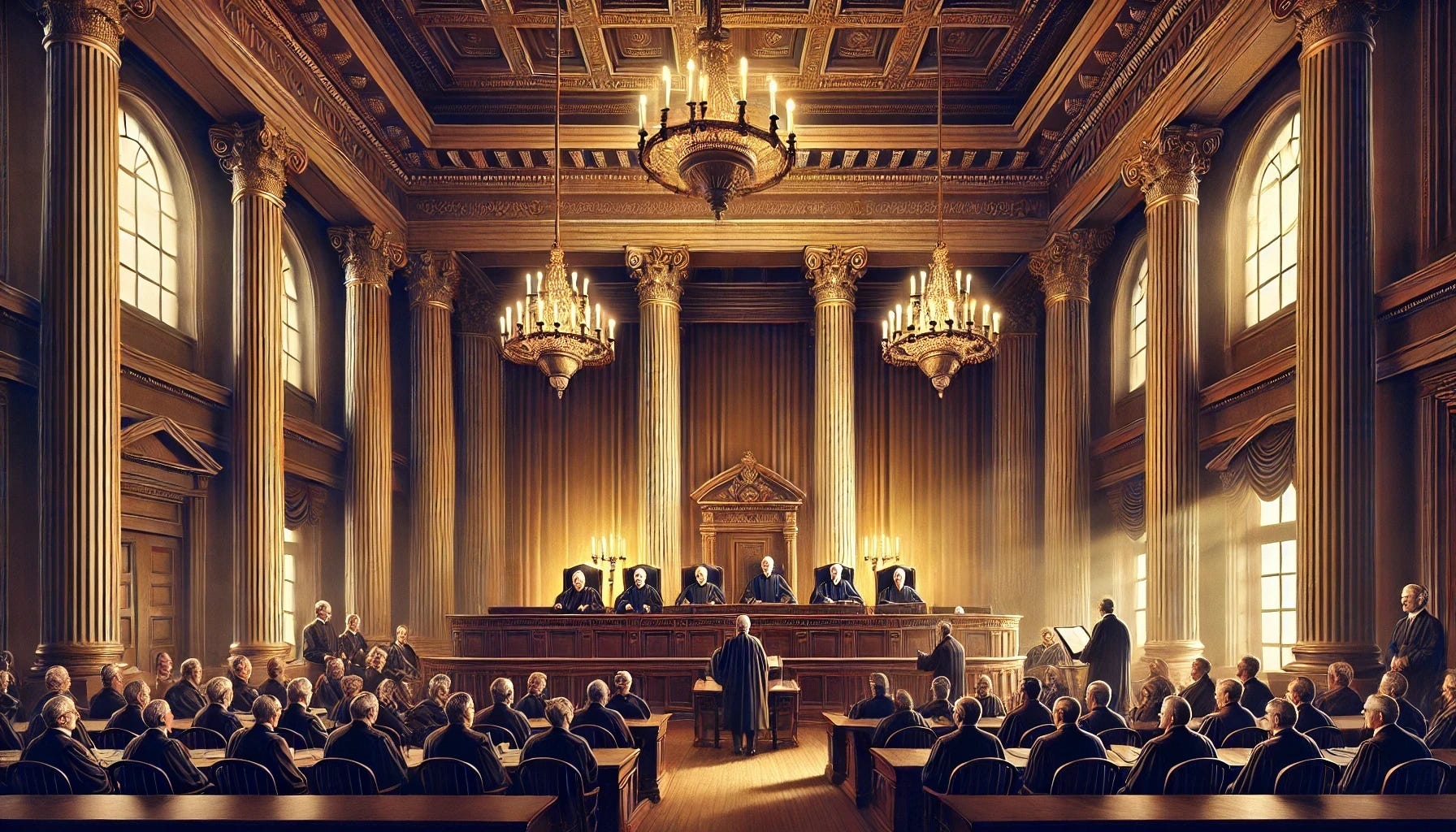
A Study of the Judiciary's Function in the Optimistic Governance Model
Among the several precautions with which the Framers of our Constitution sought to guard against the encroachments of power, none was observed as having greater necessity than that of a division of authority among the several departments of government. The experience of history, in its manifold examples of tyranny, has revealed that the accumulation of legislative, executive, and judicial functions within a single body is the surest means of reducing free government to despotism. It was therefore the design of our constitutional fabric to institute a government of checks and balances, wherein each department would serve as a bulwark against the usurpations of another.
Yet, as has been demonstrated in the celebrated case of Marbury v. Madison, the principle of separation, while preserving the liberties of the people, is neither without difficulty in its application nor free from the hazard of undue aggrandizement of one branch over the others.
The question before us, which must concern every true republican, is whether the judiciary, in asserting the power of judicial review, has acted as a rightful guardian of the Constitution or as an innovator, assuming an authority not explicitly granted by the instrument itself.
It is to this matter that this analysis shall now be directed.
The Judiciary as Guardian of the Constitution
It has long been understood that the security of our liberties requires that the acts of government be circumscribed within the bounds of constitutional authority. If, then, a law should be enacted contrary to the supreme charter, by what means shall its repugnancy be corrected? If the legislature, which is itself bound by the Constitution, should transgress its prescribed limits, ought not some authority be entrusted to declare its error? Shall the people await the slow remedy of elections, meanwhile suffering the oppression of an unconstitutional measure, or must there be an intermediate power to suspend such a law in its course?
The Constitution, much like a well-designed governance protocol, operates through layered mechanisms to ensure its integrity is upheld. As Madison noted during the Constitutional Convention...
"A law violating a constitution established by the people themselves, would be considered by the Judges as null & void."
This reinforces the judiciary’s duty to invalidate laws that contravene the Constitution, aligning with its role as a fraud-proof verification mechanism within the governance structure. In this model, Congress acts as the primary validator, proposing laws under the presumption of constitutionality, much as an optimistic rollup assumes the validity of transactions. The Executive, entrusted with enforcement, is provided with a pre-execution challenge window in the form of the veto, whereby laws that appear suspect may be halted before their finalization. The Judiciary, as a fraud-proof verification mechanism, serves to review challenged statutes and determine whether they align with constitutional constraints.
However, it is crucial to recognize that judicial review does not confer finality in a manner that renders future challenges obsolete. While blockchain transactions, once validated, are typically immutable, a human-operated optimistic execution system allows for continuous constitutional challenge through multiple mechanisms:
Judicial Reexamination: A precedent established in one era may be revisited in another when new arguments, evidence, or constitutional interpretations arise.
Executive Branch Challenges: The Department of Justice, through the Solicitor General, may bring new arguments before the Supreme Court, seeking to alter prior rulings.
State-Level Resistance: States may challenge the application of federal law through litigation, asserting their sovereign rights within the constitutional framework.
Citizen Litigation: Individuals retain the right to bring cases before the judiciary, ensuring ongoing scrutiny of prior decisions.
Legislative and Constitutional Overrides: Congress may enact new laws addressing prior rulings, and the people, through constitutional amendment, can overturn even long-standing judicial precedents.
This characteristic ensures that no single judicial ruling assumes the weight of immutable law, lest the republic be governed not by the Constitution itself, but by periodic review of interpretations of precedent in a manner that renders future challenges obsolete. Unlike blockchains, which generally do not allow repeated challenges to finalized transactions, a human-operated optimistic execution system allows continuous constitutional challenge, ensuring that new evidence or evolving legal interpretation can prompt renewed scrutiny, so too may a judicial ruling be subjected to renewed constitutional scrutiny.
If a court errs in its judgment, there exists no absolute prohibition against reexamining the matter. The Supreme Court, like a well-constructed, human operated validation mechanism, is itself subject to ongoing challenge by the people, the states, and the legislative process. A precedent established in one era may, upon later scrutiny, be found inconsistent with the Constitution’s original constraints and thus be overturned. This characteristic ensures that no single judicial ruling assumes the weight of immutable law, lest the republic be governed not by the Constitution itself, but by periodic review of interpretations of precedent.
Furthermore, the continuous opportunity to challenge the judiciary serves as an inherent check on judicial power through multiple mechanisms:
Department of Justice Oversight: The DOJ, through the Solicitor General, brings arguments before the Supreme Court to challenge rulings that may require reconsideration.
State Challenges: States, through litigation, assert their rights and challenge judicial decisions that may encroach upon their sovereignty.
Citizen Engagement: Individuals can bring cases before the judiciary, ensuring that constitutional interpretations remain subject to ongoing scrutiny.
Legislative Action: Congress retains the authority to pass new laws or initiate constitutional amendments to overturn erroneous judicial rulings.
Supreme Court Reexamination: The Court itself may revisit past rulings, overturning or modifying precedent in light of new legal arguments and societal developments.
The Department of Justice, operating within the Executive Branch, holds the authority to bring arguments before the Supreme Court, primarily through the Office of the Solicitor General. The Solicitor General represents the United States government in cases before the Court, determining which cases to appeal and filing amicus curiae briefs in significant constitutional and legal disputes. This function is a key mechanism by which the Executive Branch checks judicial decisions and engages in the ongoing process of constitutional interpretation, acting as a counterbalance against erroneous or overreaching judicial rulings.
The several States, through their own legal mechanisms, may also challenge federal laws and court decisions, asserting their sovereignty within the federal structure.
Citizens themselves, through petitions, referenda, electoral influence, and direct litigation, exert pressure on the judicial system, ensuring that the courts remain accountable to the principles of republican government. Indeed, individual litigants have the ability to bring cases before the Supreme Court when constitutional questions arise, thereby directly challenging judicial interpretations and ensuring that the law remains in alignment with the principles of the Constitution.
These avenues of challenge prevent the judiciary from becoming an unchecked authority and reinforce the Constitution’s role as the ultimate arbiter of law, rather than any particular court’s interpretation of it.
The Supremacy Clause and Constitutional Primacy
The Supremacy Clause (Article VI, Clause 2 of the U.S. Constitution) establishes that the Constitution, federal laws, and treaties take precedence over state laws, directly impacting the role of judicial review.
State courts are bound by the Supremacy Clause, meaning they must apply federal law even if it conflicts with state law. However, they also serve as an additional venue for constitutional challenges, as state courts may interpret the Constitution independently and sometimes issue rulings that prompt review by the U.S. Supreme Court.
This dynamic ensures that constitutional interpretation is not confined solely to the federal judiciary, reinforcing the principle that judicial power remains subject to multiple layers of challenge and correction. The Supremacy Clause plays a crucial role in this process, ensuring that the Constitution remains the highest legal authority, overriding conflicting state laws and reinforcing the necessity of judicial review as a safeguard.
This clause ensures that judicial decisions, while subject to ongoing challenge, remain anchored in constitutional supremacy. Thus, judicial review, as exercised in Marbury v. Madison, must be understood not as an arrogation of power but as an essential component of an orderly system, preserving the supremacy of constitutional constraints within a federated governance structure while allowing for continual challenge where necessary.
The Risks of Judicial Overreach and Supremacy
While it is one thing to grant the judiciary the authority to refuse to execute unconstitutional laws, it is quite another to elevate the courts as the supreme and final arbiter of constitutional meaning, above all other departments of government.
Nowhere in the Constitution is it declared that the judiciary alone shall be entrusted with the final interpretation of the document. As Madison warned in the Report of 1800...
"The resolution supposes that dangerous powers, not delegated, may not only be usurped and executed by the other departments, but that the judicial department, also, may exercise or sanction dangerous powers beyond the grant of the Constitution."
This underscores the potential for judicial overreach and the necessity of maintaining checks on the judiciary. The same oath to uphold the Constitution which binds the judge binds also the legislator and the executive. Were it otherwise, then we should have erected not a government of coequal departments, but one in which the judiciary, through the steady accumulation of precedent, might establish itself as an authority superior to the other branches. Such a doctrine would contravene the very balance which the Framers sought to preserve.
If the judiciary were to overstep its function and extend its authority beyond the challenge mechanism, declaring itself the final voice on all matters constitutional, it would distort the model upon which our government was framed.
The constitutional system is designed to support multiple layers of validation: the states act as independent governance forks, capable of nullifying laws that violate their sovereign compacts; the citizens, through elections and referenda, serve as decentralized governance agents, withdrawing their stake from errant legislators; and the amendment process serves as the ultimate rollback mechanism, allowing the people to correct systemic failures through a fundamental override.
Moreover, the judiciary must remain mindful that its interpretations are subject to subsequent constitutional challenges, whether through direct cases overturning precedent, through state-level resistance, or through the slow yet deliberate process of constitutional amendment. This ensures that no ruling may claim permanence, and the fundamental challenge process remains perpetual, rather than terminal.
To maintain balance, governance slashing conditions, such as impeachment or amendment overturns, must remain active to counteract judicial overreach, much as validator misbehavior in a Proof-of-Stake system results in penalties. State nullification and jury nullification serve as decentralized challenge mechanisms, ensuring that finality is not dictated solely by the judiciary but remains a product of multiple governance layers.
Thus, while the judiciary rightly acts as a constitutional fraud-checker, it must be restrained from evolving into an unchecked validator, as history has demonstrated instances where judicial overreach has later been corrected.
West Coast Hotel Co. v. Parrish (1937) Overturning Lochner v. New York (1905)
Lochner struck down labor regulations under an expansive interpretation of economic liberty, limiting legislative power beyond constitutional warrant.
Decades later, West Coast Hotel reversed this by reaffirming legislative authority in economic regulation, illustrating how judicial overreach can later be corrected.
This case exemplifies that no judicial ruling should be immune from challenge, reinforcing the doctrine that constitutional interpretation must remain adaptable to the perpetual scrutiny of law and governance. overriding the authority of the legislative and executive bodies, whose independent constitutional responsibilities must remain inviolate.
Korematsu v. United States (1944) Overturned by Trump v. Hawaii (2018)
Korematsu upheld the internment of Japanese Americans during World War II, an egregious overreach of federal authority.
In Trump v. Hawaii, the Supreme Court explicitly repudiated Korematsu, recognizing it as a grave constitutional error.
This reversal underscores how judicial rulings, even those upheld for decades, are never beyond challenge and correction.
Judicial Power as a Self-Correcting Mechanism
Thus, in reviewing the case of Marbury v. Madison, It can be observed that while judicial review is a necessary safeguard, it is not without peril. If properly confined, it serves to uphold the Constitution; if left unchecked, it may elevate the judiciary above the political branches, subverting the very republican principles it was intended to protect.
The people, whose liberties depend upon the balance of power, must ever remain vigilant against the accumulation of authority in any one branch—be it legislative, executive, or judicial. The Optimistic Rollup model of governance demonstrates that constitutional processes function best when multiple challenge pathways exist to correct errors even after they reach finalization. Marbury was one such correction, but the continued health of the republic depends on ensuring that no one branch dominates the constitutional process unchecked.
Only by preserving the spirit of divided power can we ensure that our government remains one of laws and not of men. And just as no legislative or executive action is beyond scrutiny, neither should judicial decrees be beyond challenge, for the eternal contest over constitutional fidelity is itself the most enduring safeguard of our republic.
If you are interested in this research, please follow our R&D work at United States Lab.