


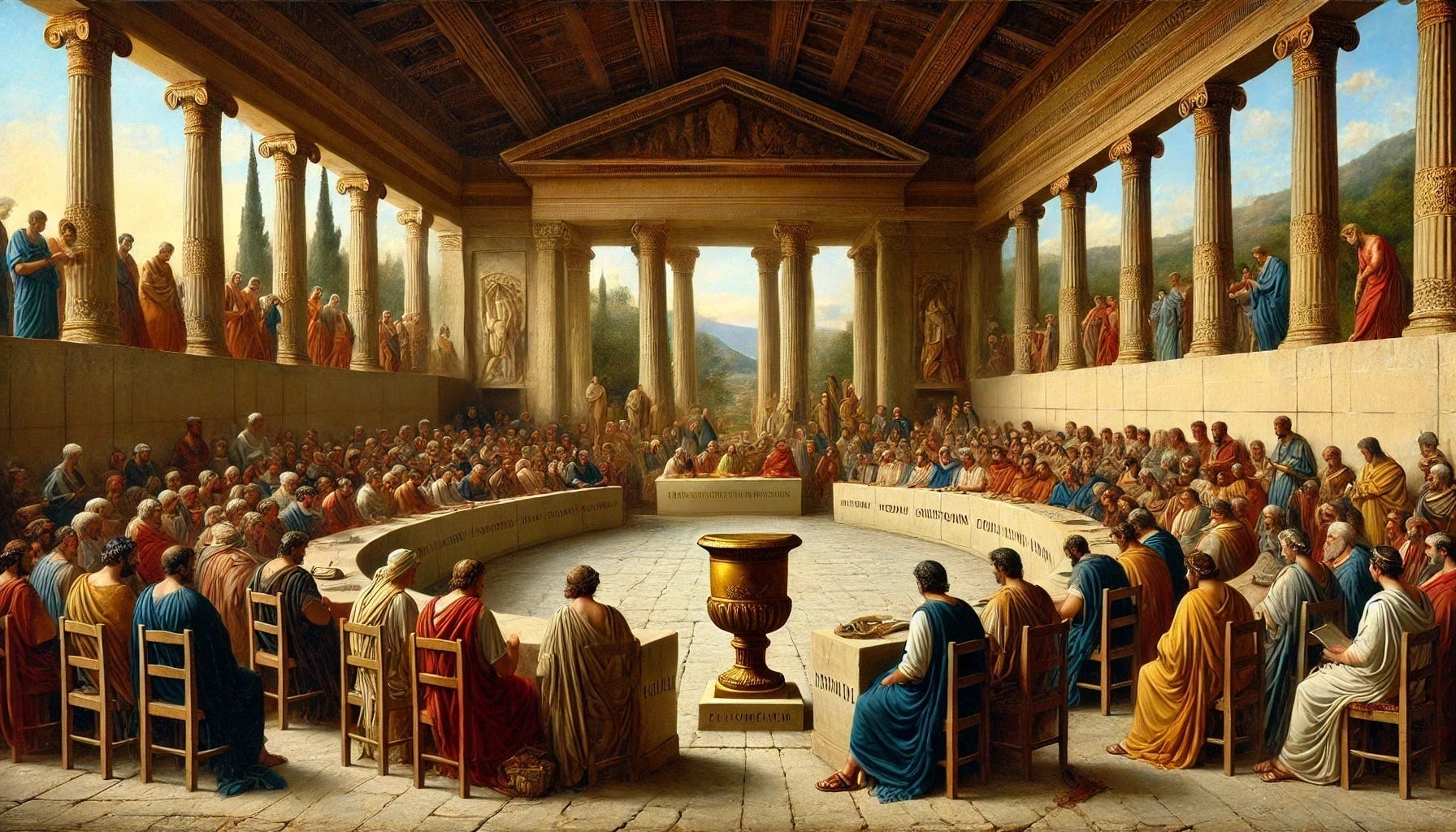
Lycia: A Near-Forgotten Republic
In the coastal region of ancient Lycia, a union of twenty-three cities achieved what few ancient states managed: a federated republic governed by proportional representation, civic autonomy, and shared executive leadership. Celebrated by Strabo and later studied in depth by James Madison, the Lycian Confederacy stood as a rare historical example of constitutional balance and civic cooperation prior to Roman conquest.
Core Mechanisms of Lycian Governance
The Confederacy divided its twenty-three cities into three classes according to power:
First-rank cities: 3 votes
Second-rank cities: 2 votes
Third-rank cities: 1 vote
This weighted voting scheme applied not only in legislative decisions, but also in taxation and duties. Each city maintained its own local governance over domestic affairs. In matters of war, diplomacy, and collective security, all cities acted through a single federal council.
No permanent capital existed; meetings occurred in the city most convenient to the situation. A central council was convened to deliberate, legislate, and appoint magistrates.
Once assembled, the federal council elected a "Lychiarch"—the chief executive for the confederacy. It also appointed additional magistrates and established courts of justice. Offices and judicial seats were distributed proportionally, ensuring non-exclusion without overrepresentation.
Principles Embedded in the Lycian Model
Polycentric Decentralization
The Lycian Confederacy exhibited polycentric decentralization—multiple autonomous cities governed themselves while contributing to a central council that addressed shared concerns. Each city acted as a self-ruling center of authority, creating a horizontally distributed system of governance without a central hegemon. This allowed for dynamic coordination, local accountability, and systemic resilience.
Subsidiarity
Decisions were made at the lowest competent level, allowing each city to govern its own domestic affairs without interference while contributing to federal decisions only where necessary. This preserved local autonomy while enhancing responsiveness and competence.
Proportional Equity
Contributions of money, manpower, and political voice were distributed in proportion to each city’s strength and capacity. Those with more resources contributed more and received a proportionate share of decision-making power, balancing responsibility and representation.
Rotation and Adaptability
With no fixed capital and a flexible approach to convening councils, the confederacy adapted to changing conditions. Governance flowed through mobile, situation-aware institutions that avoided centralized ossification.
Federated Union
Despite their independence, all cities operated within a shared constitutional structure and submitted to the authority of the central council for matters of collective concern. This balance created a resilient unity without coercive centralism.
Influence on Madison and the U.S. Constitution
James Madison reviewed the Lycian model as part of his exhaustive study of ancient and modern confederacies while preparing for the Constitutional Convention. In Federalist No. 9 and No. 39, Madison alluded to the need for a union that could preserve both the liberty of smaller states and the strength of the whole.
Strabo is the primary ancient source who describes the Lycian League in detail. In Geography (Book 14, Chapter 3), he outlines:
“The League of the Lycians is the most highly organized of all unions of cities... They have twenty-three cities; they assign three votes to the largest cities, two to the medium ones, and one to the smallest; then they deliberate in common on public affairs and appoint the Lyciarch and other officers and judges in proportion to the votes.”
This is the very passage James Madison cited in his analysis of ancient confederacies while preparing the U.S. Constitution.
Weighted Representation
The U.S. Senate provides equal votes to states regardless of size, like the Lycian cities having votes by class, while the House of Representatives balances this with population-based proportionality—an example of formal apportionment based on census data to reflect population shifts over time.
State Autonomy
Like Lycian cities, U.S. states maintain control over domestic matters. They legislate on issues such as education, property, local commerce, criminal law, and infrastructure. This structure allows each state to reflect the needs, values, and cultures of its population, reinforcing a decentralized foundation for the broader union.
Federal Coordination
The federal government addresses matters that exceed the scope of individual states, such as defense, foreign diplomacy, interstate commerce, and immigration. This echoes the Lycian council’s responsibility for collective security and external policy, where local jurisdictions pooled sovereignty only when unity was necessary.
No Fixed Capital, Initially
Before Washington, D.C. became the permanent capital, the U.S. Congress met in multiple cities—including Philadelphia, New York, and Princeton—depending on circumstance. This rotating seat of government provided logistical flexibility and mirrored Lycia’s practice of convening councils in the most convenient city, avoiding the rigidity of centralization.
Layered Authority
Though not proven in written records, it's likely that local governments mirrored the federal model in form if not in scale, with:
Elected or appointed magistrates (like archons or strategoi)
A city council or assembly to deliberate on civic matters
Judicial bodies to handle disputes
This makes sense for two reasons:
Lycia was deeply influenced by Greek civic architecture and legal norms.
A federated system based on ranked cities would function best if each unit could self-regulate with a stable, civic structure.
Madison’s compound republic design—in which local, state, and federal governments act directly on the people—mirrors the Lycian balance of city-level and federal authority. Each layer has its own jurisdiction, yet all are integrated into a constitutional whole, allowing for concurrent governance that reinforces stability through shared responsibility and mutual limitation.
Presidential Role and the Lychiarch Parallel
The U.S. President occupies a role analogous to the Lychiarch, elected not by popular vote but through a federated mechanism—the Electoral College. Like the Lychiarch, the President executes the collective will of the union while standing as its symbolic and practical executive head. Madison’s design expanded the scope of this role: the President has independent powers in treaty-making, vetoes legislation, and commands the armed forces. This reflects a fusion of federated republican execution and the necessities of a unified modern state—elevating the executive role beyond what the Lycian model required, but retaining the spirit of accountable, term-bound leadership chosen by federated consent.
Parallels to Blockchain and Decentralized Governance
Modern blockchain-based governance systems mirror several of the design features found in the Lycian Confederacy:
Multi-tiered Voting Power —Token Classes
Similar to the Lycian class-based vote weighting, blockchain DAOs often implement token-based or role-based vote weights. Validators, delegates, or stakeholders with greater contributions often have proportionally higher influence.
Decentralized Autonomous Jurisdictions
Each Lycian city retained domestic autonomy, akin to how sub-DAOs or app-specific rollups operate independently while still participating in the wider ecosystem.
Rotational Leadership and Modular Governance
The rotating council meetings of Lycia resemble on-chain DAO proposal systems where decision-making is non-centralized and flows through proposals rather than fixed capitals. This structure also mirrors the concept of stake delegation during governance epochs, where tokenholders delegate authority to validators or representatives for limited durations. Just as Lycia's leadership and council convenings rotated according to circumstance and needs, many blockchain governance systems assign authority in cycles, allowing for dynamic adaptation, reconfiguration of leadership, and temporal distribution of responsibility and influence.
Lychiarch as Elected Executive
The Lychiarch function is mirrored in DAOs through elected multisig signers, execution-layer validators, or on-chain stewards with limited mandates. In the U.S. model, the President expands upon this executive pattern by serving not only as a validator of the collective will but also as a constitutional steward with independent powers. The President’s role includes execution, veto, treaty-making, and military leadership—making the office a more comprehensive and strategically empowered counterpart to the Lychiarch, while still rooted in federated legitimacy and limited term accountability.
Proportional Duty and Equity in Rewards/Costs
Just as the more powerful cities paid more taxes and bore more responsibility, modern PoS systems ensure that validators or stakers with larger stakes take on more verification duties—and are rewarded or slashed accordingly.
Federation Logic without Centralization
Lycia’s confederacy maintained unity while avoiding tyranny by ensuring proportional input, local sovereignty, and layered defense—similar to how blockchain networks are composed of interlinked but sovereign nodes.
An Enduring Constitutional Prototype
Though the Romans eventually absorbed Lycia, dismantling its unique political structure, the memory of its republican genius persisted. Madison’s work brought that memory to life again—not as a relic of an ancient past, but as a foundation for the future. The Lycian Confederacy’s commitment to proportional equity, subsidiarity, and federative union helps shape the most successful modern republic in history. Its spirit endures in the architecture of the U.S. Constitution.
Likewise, the Lycian design principles are experiencing new life through blockchain-based governance frameworks. As DAOs, L2 systems, and decentralized councils evolve, they echo the ancient logic of federated self-rule, weighted duty, and proportional influence. The constitutional legacy of Lycia remains a guidepost for both republics and protocols.
At United States Lab, we are implementing the United States Constitution's compound republic governance model in web3. If you are interested in this research, please follow our R&D work.