


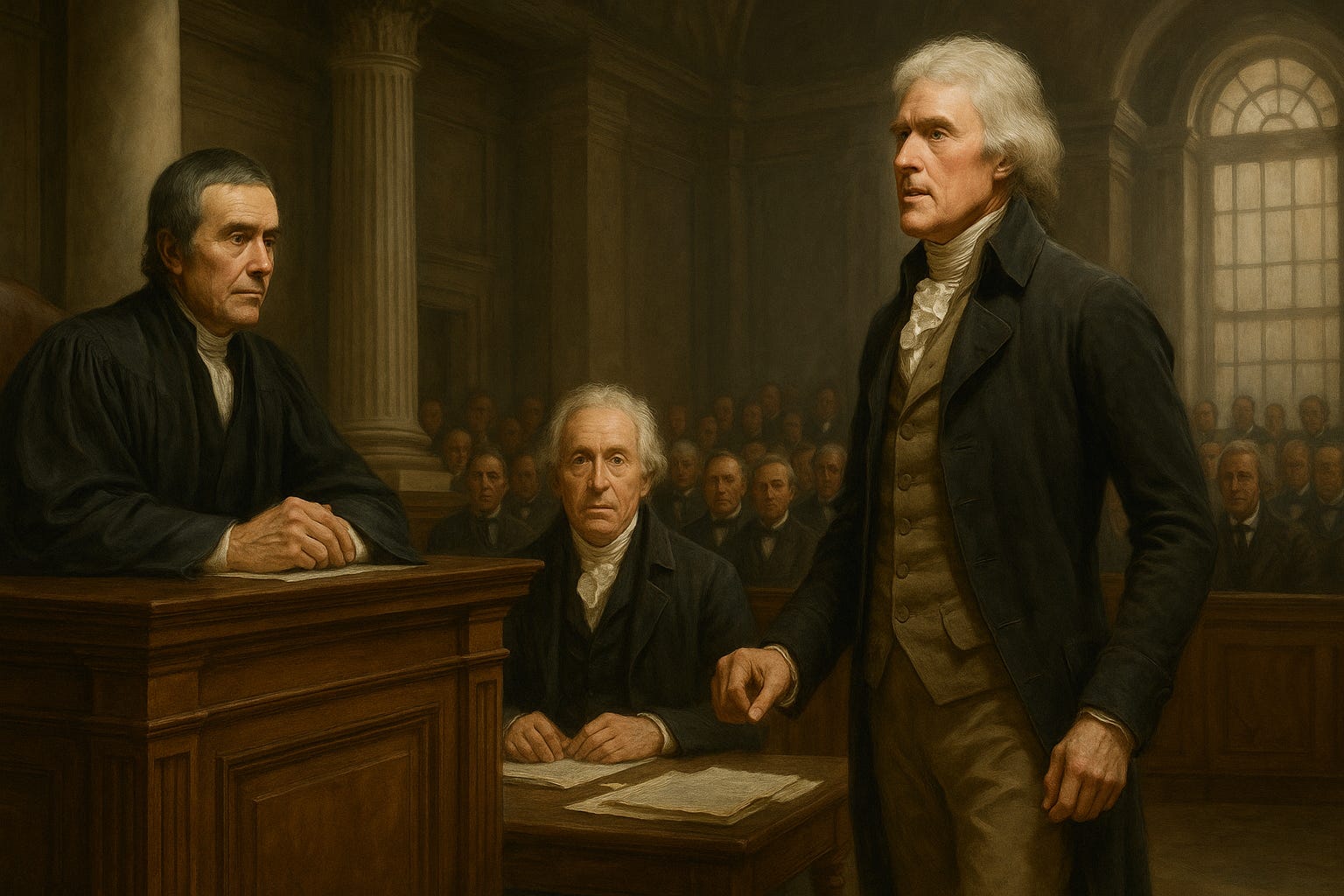
James Madison, the master architect of the compound republic, pressed a distinction that keeps the American experiment anchored: constitutional supremacy versus judicial supremacy. The Constitution, ratified by the People of the several States, stands as the highest rule of governance. Every oath‑bound officeholder (legislator, executive, or judge) swears fidelity to that charter. The oath runs to a text adopted by the People, not to a shifting line of opinions from any one branch.
Preserving that order protects the republic’s first principle: sovereignty resides with the People. The Constitution is their instrument; branches are its servants. Courts therefore carry a crucial responsibility, adjudicating concrete disputes under the charter, but they do not become the sovereign mouthpiece of constitutional meaning for every actor in every context. Legislators and executives must cultivate an independent constitutional conscience; their duty is not fulfilled by speculating about, or deferring to, what courts might say later.
This introduction sharpens Madison’s distinction, traces how he articulated it across decades, and distills its operational consequences today, why each branch must interpret within its lane; why Citizens remain the ultimate guardians through elections and Article V; and why confusing judicial review with judicial supremacy risks consolidating power in the least‑electable department.
Judicial Review vs. Judicial Supremacy
When Americans today hear the phrase Marbury v. Madison, they often think of judicial review, the practice by which courts refuse to give force to statutes or executive acts that conflict with the Constitution. This doctrine is both true and important, for it ensures that the written charter remains superior to ordinary law in concrete disputes. Madison’s warns us that judicial review must never be mistaken for judicial supremacy.
Judicial review is bounded: it operates within the judiciary’s lane of deciding real cases with real parties, applying constitutional rules to the controversies before the court. Its authority is tied to the resolution of disputes and the reasoning provided in that context.
Judicial supremacy, by contrast, would elevate the judiciary into an unelected oracle, whose pronouncements function as binding amendments on every branch and actor, regardless of case or circumstance. Such a doctrine would turn precedent into a substitute for Article V amendment and diminish the duty of legislators and executives to keep their own constitutional consciences active.
For Madison, this transformation would not strengthen liberty, but endanger it. If judicial opinions were allowed to displace the People’s sovereign authority to amend and correct their charter, or to relieve other branches of their independent oath-bound duties, then the balance of the compound republic would collapse into judicial sovereignty.
Madison’s architecture was meant to disperse interpretive authority across all departments, not concentrate it in the least-electable branch.
Madison’s Vision of Departmentalism
Madison’s view can be traced from the ratification debates, through his leadership in the Virginia Resolutions, and into his later writings in response to expansive rulings like McCulloch v. Maryland. At each stage, he reaffirmed the principle that constitutional interpretation is not monopolized by the courts, but is a distributed duty across all branches and levels of government. During the ratification debates, Madison emphasized that the Constitution derives from the People’s sovereign assent, an instrument to be upheld by all who swear an oath.
It is to be the assent and ratification of the several States, derived from the supreme authority in each State, the authority of the people themselves. The act, therefore, establishing the Constitution, will not be a NATIONAL, but a FEDERAL act. — James Madison, Federalist No. 39
In the Virginia Resolutions and his Report of 1800, he argued that when Congress oversteps its enumerated powers, the states have a lawful duty to call attention to the usurpation and press remedies through political and constitutional channels.
“The Constitution of the United States was formed by the sanction of the States, given by each in its sovereign capacity. It adds to the stability and dignity of the Constitution, that it rests on this legitimate and solid foundation. The States then being the parties to the constitutional compact, and in their sovereign capacity, it follows of necessity that there can be no tribunal above their authority.” — James Madison, Report of 1800
In later years, responding to broad constructions like those in McCulloch v. Maryland, Madison reminded his correspondents that Congress must continually test legislation against enumerated powers, that Presidents must use the veto not merely as a political tool, but as a constitutional filter, and that courts must strike down laws only in the context of real controversies.
He stressed that the states retain a role in contesting federal overreach through petitions, litigation, coordinated opposition, and proposals for amendment, tools that keep them within the constitutional order. Above all, Madison insisted that the People remain the ultimate arbiters. Through elections, public opinion, and Article V amendments, they exercise the final authority to correct errors, check ambition, and upgrade the constitutional framework. This vision ensures that every part of the republic maintains an active constitutional conscience rather than outsourcing judgment to a single branch.
The Dangers of Outsourcing Constitutional Duty
This position, sometimes called departmentalism, anchors Madison’s philosophy because it forces each branch to exercise its own constitutional conscience rather than handing that responsibility away. It preserves checks and balances by ensuring no branch outsources its constitutional oath to another, thereby maintaining multiple guardrails against error and ambition.
When Congress or the President relinquishes this duty and simply defers to judicial pronouncements, the balance of power tilts dramatically toward the courts. Judicial opinions then cease to be limited judgments in particular cases and instead operate as general commands that bind every political actor. This change effectively transforms the judiciary from one coordinate branch into a dominant power center.
In such a system, mistaken precedents would calcify into permanent policy without the People’s consent, creating de facto amendments that bypass Article V and entrench judicial constructions beyond correction by ordinary political means. Here the doctrine of stare decisis, the judicial practice of following prior decisions, can magnify the danger Madison foresaw. Instead of providing stability within the judicial lane, stare decisis under a regime of judicial supremacy can lock in constitutional errors and prevent other branches or the People from exercising their corrective powers. Precedent thus becomes not merely guidance but an almost unalterable rule, raising the cost of correction and turning temporary misjudgments into structural distortions.
The legislative and executive branches would see their authority hollowed out, and the states would lose their capacity to resist centralization, deprived of lawful avenues to contest expansive interpretations. Citizens, too, would suffer from this imbalance, they would lose the habit of engaging in constitutional reasoning themselves, believing instead that the Court alone speaks for the Constitution and relieving elected officials of their sworn duty.
Madison warned that this civic atrophy is as dangerous as factional capture. Once the judiciary assumes supremacy and stare decisis hardens its rulings into pseudo-amendments, the People risk becoming subjects of judicial will rather than sovereigns of a constitutional republic, and the careful equilibrium of the compound republic is displaced by the dominance of a single branch.
Madison’s Middle Ground
Madison also rejected the opposite extreme, the idea that any single state could unilaterally nullify federal laws. He viewed such a claim as incompatible with a durable union, majority rule among the several States, and the People’s retained authority to revise the charter only through the forms it prescribes. A single‑State veto would let a minority govern the whole, dissolve uniform national rules, and replace constitutional settlement with recurring standoffs.
His solution keeps resistance and correction inside the Constitution’s channels. It preserves constitutional remedies within the system itself, avoiding both concentration of power in one branch and revolutionary fragmentation across fifty separate sovereignties. Madison’s middle ground is a ladder of remedies, political, legal, intergovernmental, and ultimately constitutional, through which Citizens and their governments confront excess and restore balance without breaking the system that secures their rights.
Unilateral nullification fails Madison’s test:
It defeats majority rule among the States by empowering the smallest minority to arrest the laws of the Union.
It bypasses Article V, turning ad hoc State objections into de facto amendments without the People’s consent.
It destabilizes federal supremacy in its proper sphere by producing a patchwork of obedience and defiance.
It invites retaliation and, eventually, disunion, sacrificing both liberty and security.
Madison’s constitutional remedies:
Public reason and persuasion — States, Citizens, and representatives publish protests, reports, and resolutions to expose usurpations and rally constitutional majorities. These are alarms and calls to deliberate, not legal erasers of federal law.
Electoral remedies — Citizens replace officials who authorized the excess; new majorities repeal or revise the offending measures; executives exercise the veto and practice faithful, bounded discretion.
Legislative oversight and repeal — Committees investigate, control appropriations, refine statutory limits, and codify clarifications that realign execution with enumerated powers.
Judicial review within cases — Parties bring concrete disputes; courts apply the Constitution and, where necessary, decline to give effect to unconstitutional acts, bounded by case‑or‑controversy, standing, and remedies tailored to litigants.
Interstate coordination — States confer, pass concurring resolutions, and form lawful compacts that amplify political pressure and sharpen constitutional questions.
Article V amendment — When disagreement reflects a durable, systemic issue, the People revise the charter through Congress or a convention of the States, with ratification restoring settled meaning for all.
Ultimate recourse beyond the charter — Only when constitutional avenues are exhausted and rights are persistently violated do the People retain the natural right of revolution, a last resort outside the constitutional order Madison designed to make unnecessary.
Power dynamics in Madison’s middle path:
Coordinate branches — Each retains an independent constitutional conscience (departmentalism), preventing any single institution from becoming the oracle of meaning.
Vital States — States remain key actors for signaling and mobilizing constitutional majorities, through persuasion, litigation, cooperation, and amendment, rather than through solitary annulment.
Sovereign People — The People reserve the “last resort” of amendment and, beyond the charter, the natural right of revolution. This hierarchy prevents courts, Congress, or any State from claiming final supremacy over the charter.
Taken together, these remedies supply an escalating, lawful toolkit by which the People, working through their representatives, executives, courts, and States, preserve constitutional governance against both legislative and judicial overreach. The process is more deliberate than unilateral nullification, yet it secures legitimacy, avoids minority rule, and keeps the compound republic intact while it corrects course.
The Core Lesson
The lesson is simple but profound, with its implications stretching across every dimension of governance. Judicial review is a necessary safeguard against unconstitutional acts, but it is not and was never intended to be the final word on the Constitution. That final word belongs to the People themselves, operating through the deliberate and orderly mechanisms provided by the charter—elections, intergovernmental contestation, and ultimately Article V amendment.
Madison’s warning was that if any branch, especially the judiciary, were permitted to function as the sole arbiter of constitutional meaning, then the very idea of a republic founded on the consent of the governed would be displaced by a system governed through judicial fiat.
In practice, this means every officeholder must regard the oath of office as a personal covenant with the Constitution. Members of Congress must evaluate whether their laws genuinely arise from enumerated powers rather than assuming the courts will sort it out later. Presidents must see the veto as a constitutional duty, not simply a political bargaining tool, and must refrain from executing measures that plainly exceed constitutional bounds. Judges must recognize the limits of their own role, deciding cases rather than redesigning the political order, and respect that their authority derives from the People’s charter, not from judicial self-assertion. States must persist in exercising their role as constitutional actors by challenging excess and organizing remedies within the system. Citizens, above all, must not abandon the practice of constitutional reasoning to elites; their vigilance and participation remain the last guarantee of liberty.
Madison’s design is therefore a practical architecture of distributed responsibility. It teaches that liberty depends not on trusting one branch but on every branch, every state, and every citizen honoring the Constitution as the highest rule of governance.
Judicial review plays a critical part in that design, but judicial supremacy would invert it, converting the least-electable branch into the sovereign and reducing the People to mere subjects. Madison’s core lesson is that the Constitution is supreme, the courts are validators within their lane, and the People retain the sovereign right to preserve, correct, and renew their own charter.
Returning to First Principles
In an era when many treat Supreme Court decisions as if they were the Constitution itself, Madison’s words summon us back to the original ground of authority. The Constitution is not merely a series of judicial interpretations layered over time, it is the written charter ordained by the People, amendable only by the People through Article V. Courts provide stability in cases through precedent, but precedent must never be mistaken for permanence; true permanence arises only from constitutional amendment. Stare decisis can guide judicial reasoning, but it cannot displace the People’s sovereign right to revise or correct the charter itself.
Returning to first principles requires remembering several truths:
First, the Constitution is supreme law, superior to both statutory enactments and judicial constructions.
Second, every branch swears an equal oath to uphold it; none may delegate this sacred duty to another.
Third, the People remain the ultimate arbiters through elections, through organized petitions and interstate coordination, and through the formal act of amendment.
Fourth, civic vigilance is essential. A citizenry that ceases to deliberate on constitutional meaning becomes dependent on a narrow judicial elite and risks losing its sovereignty.
Madison’s design ensures that liberty is preserved not by the monopoly of interpretation in one branch, but by a system of distributed responsibility in which every department, every state, and every citizen guards the Constitution in their own sphere. To live by first principles is to recognize that the judiciary has an important but bounded role, that the legislature and executive must honor their independent oaths, and that the People themselves must remain actively engaged. Only when all of these forces remain in motion does the compound republic endure.
The preservation of liberty therefore depends not only on reading the Constitution as the highest law, but also on practicing it as the shared duty of the entire republic. To forget this is to risk becoming governed by precedents and pronouncements rather than by the charter the People themselves established. To remember it is to preserve the foundation of self-government for generations yet to come.
United States Lab’s Polylithic Governance Model
Madison’s warning about judicial supremacy has a modern analog in the design of governance protocols. United States Lab directly addresses the problem by ensuring that no single validator set (legislative, executive, or judicial) can become the exclusive oracle of constitutional meaning. In the Polylithic Governance model, each department validates within its own sphere, creating distributed constitutional interpretation that mirrors Madison’s principle of departmentalism.
It also builds in challenge mechanisms to preserve sovereignty at the citizen layer. The Citizen Challenge primitive guarantees that any citizen can file a constraint‑violation proof, just as Madison insisted that the People are the final arbiters. Likewise, Adjudication & Reversibility ensures that unlawful or erroneous state transitions can be reviewed and rolled back, but without granting the judiciary monopolistic authority over the entire system.
Another safeguard is the distinction between precedent and amendment. Judicial decisions serve as guiding precedent, but cannot alter the constitutional ledger on their own. True, binding change comes only through Epoch Renewal and Threshold Voting on Article V–style amendments, which anchor constitutional settlement back to the sovereign People. This design prevents stare decisis from becoming a form of de facto amendment, the very drift Madison warned against.
Finally, the guardian validator of last resort (the President with his special oath) ensures that if any validator set (including the judiciary) strays toward oligarchic control, the system can be defended and reset. This aligns with Madison’s vision that liberty depends on balancing powers rather than concentrating them.
Through these mechanisms, United States Lab operationalizes Madison’s insight. Judicial review is a legitimate safeguard, but judicial supremacy is an attack vector. Sovereignty belongs not to one branch, but to the People, cryptographically enforced at the foundation of the governance protocol.
At United States Lab, we are implementing the United States Constitution's compound republic governance model in web3. If you are interested in this research, please follow our R&D work.