


How Veto Mechanisms Safeguard Against Governance Failures
In governance, systems require forces that act as checks against the reckless acceleration of raw power. The veto power, whether in the hands of the President of the United States or encoded within a DAO, is such a force. It is the mechanism by which governance tempers hasty decision-making, ensuring that resolutions align with the core principles of a system rather than being dictated by the ephemeral whims of the moment.
James Madison, in constructing the U.S. Constitution, saw veto power as a necessary bulwark against legislative excess. The Executive’s ability to reject a bill was not only a safeguard against poor policy, but a structural guarantee that major decisions underwent sufficient scrutiny. Today, in DAOs, where governance is decentralized and code replaces parchment, the veto ensures that no faction or transient majority can act rashly to the detriment of the system.
In a DAO, veto power can be assigned to a governance council, a multi-signature committee, or an elected executive function. Unlike in traditional governance, where human discretion plays a key role, blockchain-based governance encodes veto authority into smart contracts, ensuring deterministic enforcement. Just as Madison sought to preserve liberty through checks and balances, DAOs use vetoes to preserve system integrity and prevent governance capture.
The Pocket Veto: A Silent Check on Governance
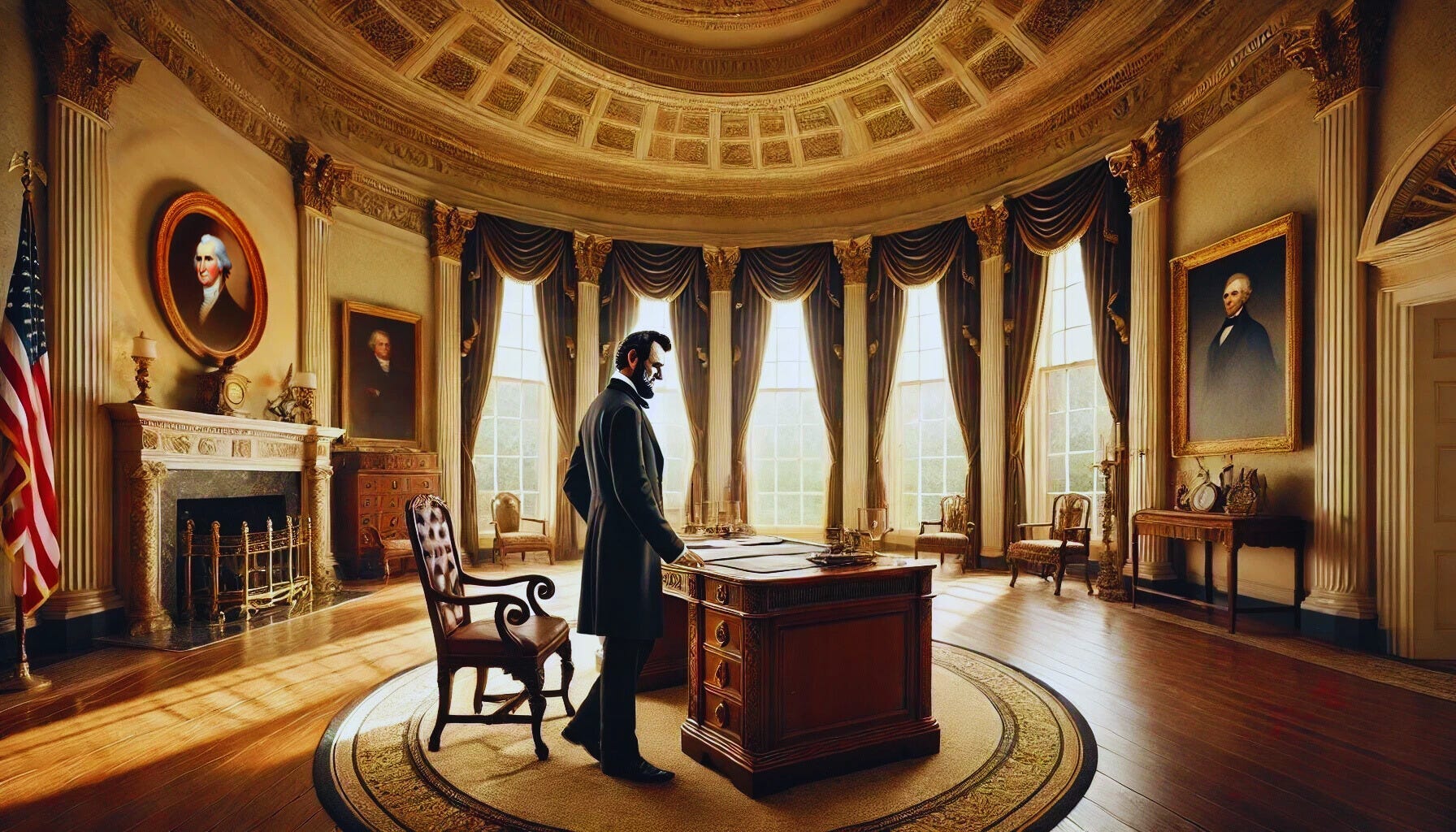
A famous historical example of an executive veto shaping governance occurred in 1864 when President Abraham Lincoln used a pocket veto to block the Wade-Davis Bill, a congressional effort to impose harsh Reconstruction policies on the South. By not signing the bill before Congress adjourned, Lincoln effectively nullified it without leaving room for an override. This maneuver illustrates the power of a silent veto—an executive safeguard against legislative overreach that DAOs could encode into governance mechanisms to ensure alignment with fundamental protocols.
The Civil War itself can be seen as an unsuccessful hard fork of the governance protocol, where the Confederate States attempted a unilateral chain split without achieving consensus among stakeholders of the U.S. governance system.
The Confederate States' representatives failed to use the proper governance process within the existing constitutional framework, and instead attempted to establish a separate governance model through a coercive Sybil attack, fabricating legitimacy outside of the agreed-upon validation mechanisms.
However, the war proved that governance forks require broad stakeholder consensus, adherence to governance validation rules, and enforceable legitimacy to succeed. Without proper validation by the recognized governance protocol, such a split is subject to challenge and rollback by the majority network participants—akin to how the Union enforced the reversion of the Confederate attempt at secession.
Without broad agreement from key stakeholders and structural robustness, a fork—like the Confederacy—can be forcibly reverted, reinforcing the importance of mechanisms like the veto to prevent irreparable schisms in governance.
The Balance Between Executive Oversight and Community Control
A governance system without checks is doomed to the entropy of bad decision-making. Yet a system with too many barriers stagnates, its engines choked by overregulation. The balance between executive oversight and community control is the fine line DAOs must navigate.
In traditional governance, the veto is wielded by a single executive—the President—who may use it to reject legislation deemed unwise, unconstitutional, or misaligned with national interests. The President is accountable to the electorate but acts independently of legislative passions, providing a stabilizing function. Similarly, in a DAO, a veto-wielding entity—be it a multi-sig council, governance validators, or a lead developer—exists to ensure decisions align with protocol integrity.
However, unchecked veto power risks mutating into a centralizing force, stifling the very decentralization DAOs seek to achieve. The ideal DAO balance, much like the U.S. system, involves a structured, transparent process where vetoes are subject to rigorous justification, and counterbalances exist to prevent abuse. A veto should not be an instrument of tyranny but of prudence—allowing time for reflection, correction, and system-wide consensus.
Lincoln’s pocket veto of the Wade-Davis Bill provides an example of how a well-timed executive action can prevent hasty or ill-conceived policy. Congress’s bill required 50% of a Southern state's population to take an oath before reentry into the Union—a measure Lincoln believed was too restrictive. His pocket veto allowed Reconstruction to move forward under a more flexible policy, reinforcing the importance of executive safeguards in governance frameworks.
The Civil War's failure as a governance fork further underscores the importance of structured veto mechanisms. A governance system without clear override mechanisms, defined security guarantees, and broad stakeholder consensus is vulnerable to fragmentation and collapse.
Just as DAOs must guard against protocol splits that weaken governance legitimacy, the U.S. had to ensure that any deviation from constitutional governance could be contained and corrected.
Smart Contract Enforcement of Vetoed Proposals
Unlike the parchment and ink of the Founders, blockchain governance does not leave room for ambiguity in enforcement. A veto in a DAO, when enacted through smart contracts, is instant and immutable—coded into the system as an automated rejection of a proposal that fails a defined test of validity.
Smart contract-based veto enforcement can take multiple forms:
Automatic execution: A governance contract prevents a proposal from proceeding if vetoed by a designated authority (such as a governance council or elected leader).
Time-locked re-evaluation: A vetoed proposal is placed in a time-lock, requiring a period of reflection before reconsideration, much like how a presidential veto can be overridden by Congress.
Stake-based challenge systems: Validators or stakeholders can challenge a veto if they believe it was misapplied, triggering a decentralized review process.
This is governance at the speed of code—swift, transparent, and resistant to human fallibility. Yet, it is imperative that the system accounts for unforeseen edge cases. In the same way that the Founders designed a system capable of evolution, DAOs must engineer smart contracts with flexibility, allowing governance to iterate while preserving first principles.
Lincoln’s pocket veto demonstrates how a time-based veto mechanism can function as an effective governance tool. By simply not acting on a proposal, Lincoln ensured that Congress had no means to override the decision, an approach DAOs could integrate through time-delayed smart contract actions that require governance review before automatic rejection.
Methods for Overriding Veto Power Through Governance Consensus
A veto is not a decree from on high—it is a safeguard, not an immovable obstacle. In the U.S., Congress retains the power to override a presidential veto with a two-thirds majority in both chambers. This ensures that if the veto is used excessively or without merit, the legislative body can still assert its representative will of the people through an extraordinary consensus.
DAOs should implement similar override mechanisms, ensuring that a veto does not become an autocratic cudgel. Some methods include:
Supermajority override: If a proposal is vetoed, a higher quorum (two-thirds or three-quarters) of governance token holders can override the decision.
Multi-stage deliberation: A vetoed proposal can enter a secondary governance phase, requiring further discussion and a final vote after a cooling-off period.
Validator-driven override: If governance validators or elected representatives believe a veto was unjustified, they can collectively override it by staking tokens against the veto.
Building a Robust DAO Veto System
From Madison onward, the lesson remains the same: governance must balance control with agility, restraint with adaptability.
"In framing a government which is to be administered by men over men, the great difficulty lies in this: you must first enable the government to control the governed; and in the next place, oblige it to control itself."
— James Madison, Federalist No. 51
The veto, whether in a constitutional republic or in a decentralized organization, is a tool for protecting against reckless governance. Yet, it must not become an instrument of stagnation.
The lesson of Lincoln’s pocket veto underscores the need for veto power as a protective yet limited tool. DAOs must carefully design their veto mechanisms to ensure that proposals can be stopped when necessary, but that governance remains adaptable to the needs of the whole system.
Likewise, the Civil War's failure as a governance fork highlights why DAOs must ensure protocol legitimacy, dispute resolution, and enforcement mechanisms to prevent disruptive splits. Governance should evolve, but it must do so with security, consensus, and adaptability at its core.
If you are interested in this research, please follow our R&D work at United States Lab.