


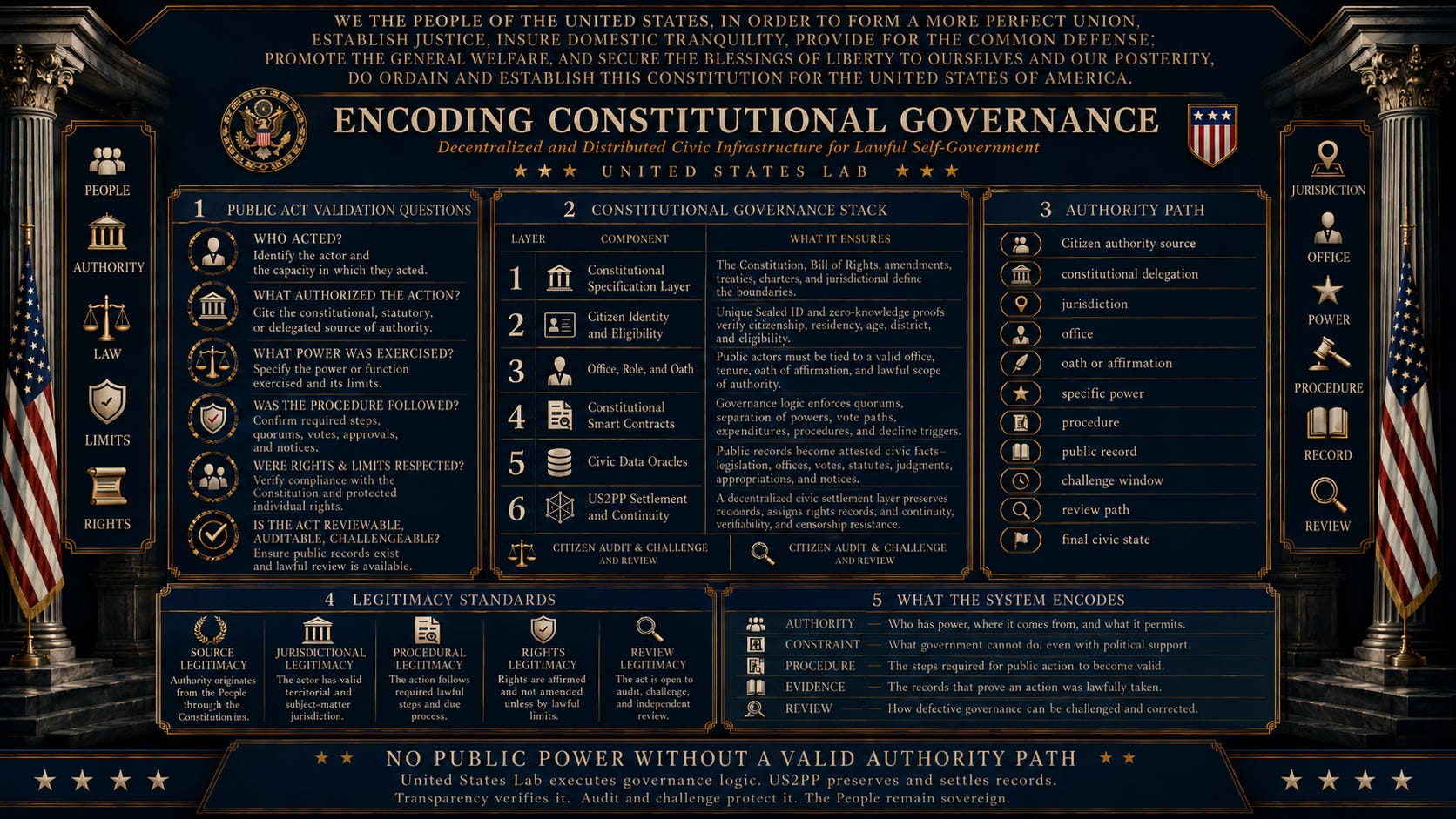
United States Protocol encodes constitutional governance as decentralized and distributed civic infrastructure. Its purpose is to make lawful authority traceable, inspectable, challengeable, and enforceable according to the Constitution.
The Constitution already operates as an enduring governance protocol specification. It defines the structure of public authority through offices, powers, constraints, procedures, jurisdictions, voting thresholds, amendment paths, rights, prohibitions, elections, appointments, removals, appropriations, oaths, and review mechanisms. It specifies how public authority is created, delegated, exercised, limited, contested, and corrected.
United States Protocol operationalizes that structure. It encodes the legitimate derivation of authority.
Every public act should be able to show where its power came from, who exercised it, what office authorized it, what procedure was followed, what rights constrained it, what records prove it, and how the act may be challenged or reviewed.
Public power becomes an attested authority path. The governing rule is simple: No public power without a valid authority path.
