


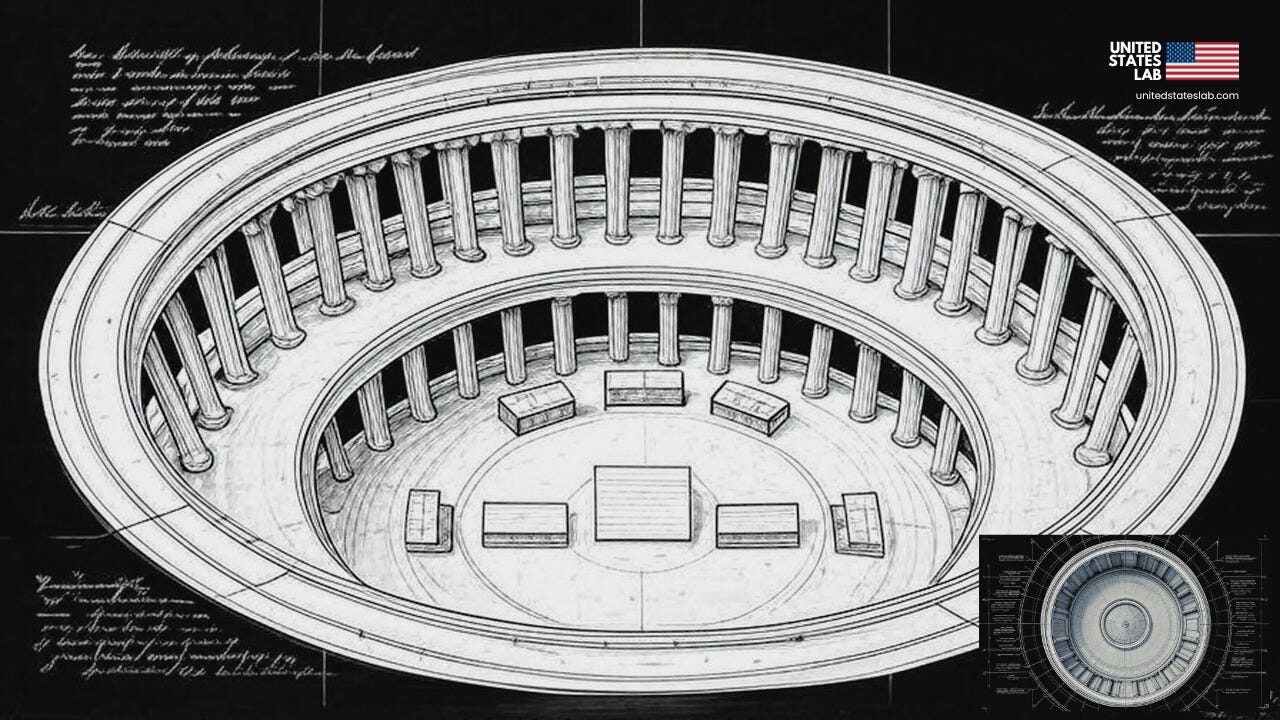
We The People
of the United States of America are the governance protocol authors. The Constitution is our canonical specification, delegating enumerated functions to bounded institutions. Every legitimate exercise of power is a read of our Constitution specification; every extension requires an amendment (Article V), not ordinary statute, not executive discretion, not judicial creativity. This is the core vestment.
Foundational Theory — From Natural Right to Constitutional Encoding
Origins in Popular Sovereignty
Natural rights → consent: Individuals possess rights prior to government. Government is instituted to secure those rights; its just powers derive from consent of the governed.
Delegation, not divestment: The people delegate limited, enumerated functions. They do not transfer their sovereignty; they lend operational authority under conditions.
Declaration to Constitution: A Two‑Step Commit
Declaration (philosophical commit): Establishes the purpose of government, the locus of authority (the people), and the standard of legitimacy.
Constitution (operational commit): Implements the design: a fixed distribution of powers, defined jurisdictions, rights constraints that bind all government action, and lawful procedures for amendment only through consent of the governed.
Vesting as a Technical Construct
“Vesting” = binding interface: Articles I–III vest specific powers in distinct branches. Vesting functions like a language-level interface:
Legislature: define general, prospective rules within enumerated fields.
Executive: faithfully execute those rules and the Constitution’s commands.
Judiciary: decide concrete cases, ensuring rule-conformant application.
Guardrails vs. throughput: More power is not “more capacity.” Constitutional throughput is bounded by guardrails that keep legitimacy intact.
System Design Parallel — Governance as a Protocol with Enumerated Modules
The Constitution as Canonical Spec
Canonical source of truth: The Constitution is the normative repo. Ordinary statutes are downstream artifacts; regulations are generated code; orders are runtime invocations. Their legitimacy is derivative—statutes may express, but never redefine, the constitutional source from which they arise.
Enumerated modules: Commerce, taxing/spending, war/peace, treaties, appointments, etc. are segmented functions with built-in constraints.
Separation as fault containment: Distinct processes prevent correlated failure and reduce blast radius when one module misbehaves.
Polylithic architecture: a federation of replicated, sovereign governance engines (federal, state, local) that each instantiate the same constitutional primitives (legislate/execute/adjudicate) while remaining locally configurable and globally coherent through constraint-verified interoperability. Engines communicate by proofs (standardized schemas, signatures, zero-knowledge attestations, and public anchors) so coordination flows through verification, not hierarchy.
Execution Function as Runtime Integrity
Obligation, Not Option
The President’s duty is a faithful execution, not policy invention. The execution layer is a validator for legislative outputs and constitutional preconditions (oath-bound). It is called faithful because the President swears an oath before the Creator to uphold the Constitution, a solemn vow understood to bind the conscience beyond temporal sanction, with accountability that reaches to the eternal state of being.
The Executive functions as an execution-layer validator, accepting or rejecting proposed state transitions based on constitutional constraints and statutory predicates, with reasoned attestations recorded for public audit and rollback when challenges succeed.
Optimistic Execution, Challenge Window
This layered system operates through optimistic execution — where federal, state, and local layers advance governance decisions in good faith and in real time, subject to later verification and correction by courts, elections, and citizen challenge. Each layer functions as a semi-autonomous validator, assuming fidelity until proven otherwise, ensuring that governance remains both efficient and accountable through iterative challenge and confirmation. Day‑to‑day governance must proceed, but remains subject to lawful challenge (judicial, legislative, and electoral) where the people, as original sovereigns, retain final authority.
Polylithic Protocol Stack (L0–L5)
L0 — Origin Signals: Natural rights and founding compacts inform oaths and constraints.
L1 — Constitutional Spec: Enumerated powers, checks/balances, quorum and challenge rules encoded as verifiable constraints.
L2 — Polylithic Replicas: State/local engines run the same governance primitives with local configuration but must emit L1-compliant proofs for any action touching shared assets, binding other jurisdictions, or altering governance configuration.
L3 — Execution Plane (Optimistic): Valid proposals execute subject to challenge windows; rollback on proven constraint violations; monetary actions time-lock until challenge expiry.
L4 — Treasury Plane: Multisig, threshold-guarded funds (PoW-secured) disburse only after bicameral passage, executive attestation, and challenge clearance.
L5 — Citizen Interface: ZK credentials for eligibility, uniqueness, jurisdiction; intent signaling; petition and zk-standing challenge submission.
Anchor & Audit: State roots and critical artifacts are timestamp-anchored to a public PoW chain for durable, neutral auditability.
Federalism as Sharded Governance
Vertical partitioning — federated shards of authority:
National, state, and local governments operate as distinct constitutional shards, each with defined data domains (powers), transaction scopes (jurisdictions), and validator sets. This vertical partitioning is realized in United States Protocol’s polylithic architecture, where every shard runs a full governance engine (legislative, executive, and judicial) anchored to the shared Layer-1 constitutional specification that ensures coherence across the republic.Local specialization — national cohesion:
States and localities retain proximity to the citizen and freedom to experiment within constitutional bounds, while the national layer sustains union-scale goods: common defense, currency, interstate commerce, and international representation. Together, they form a resilient, self-balancing system where diversity of governance strengthens, rather than fragments, the whole.
Federal Supremacy and the Anchoring Chain
Constitutional supremacy, not national centralization:
The Supremacy Clause establishes that the Constitution and laws made in pursuance thereof form the supreme law of the land. This supremacy belongs to the federal compact, not to a national hierarchy; it binds all jurisdictions through consent and constraint, not command.Cryptographic implementation of federal supremacy:
In United States Protocol’s polylithic architecture, this principle is realized through a Proof-of-Work anchoring chain, where finalized state roots, validator attestations, and challenge outcomes are immutably recorded on a neutral public ledger . This anchor enforces coherence across all replicas — federal, state, and local.Immutable verification, not administrative control:
The anchoring chain provides an immutable, confirmed record of constitutional state, functioning as the protocol’s federal supremacy layer. It ensures that every lawful act, amendment, or rollback is publicly verifiable and historically final, independent of transient validator control.Supremacy as cryptographic truth:
What the framers achieved through legal structure, a unified yet distributed republic, is here enforced by physics and mathematics. The same clause that made the Constitution supreme in law now finds expression in verifiable computation, federal supremacy rendered cryptographic.
Article V as the Only Upgrade Path
No informal amendment may substitute for the constitutional process of Article V: You cannot “hotfix” the protocol with a statute or memo. Protocol upgrades require Article V — a supermajoritarian people‑and‑states pathway.
State primacy in upgrades: States, as agents nearest to the people, co-own the upgrade path; Congress proposes but does not own the spec.
State-Operated Ratification as the Constitutional Upgrade Mechanism:
While Congress may initiate proposals or call a convention upon application of two-thirds of the states, the amendment process itself is completed only through the ratification of three-fourths of the states.This structure ensures that constitutional change originates within the consent of the governed at the most distributed level of sovereignty.
Congress serves as the proposal relay, but the states act as the validator mesh — a supermajoritarian consensus that authenticates any modification to the core protocol.
The amendment process, therefore, remains fundamentally state-operated, preserving the people’s authority through their state governments and preventing unilateral federal alteration of the constitutional architecture.
Citizen Challenge as a Governance Primitive
Standing, petitions, elections: Citizens provide the continuous audit stream: litigating, petitioning, voting, assembling, speaking.
Transparency and reason-giving: Legitimate governance explains itself. Reason-giving is a validation proof, not a courtesy.
Operational Implications Over Time — Diagnosing Drift and Overreach
Legislative Drift
From enumerated to plenary: When Congress treats enumerated powers as general police power, it implicitly attempts a protocol rewrite without Article V.
Proxy legislation through delegation: Overbroad delegations to the administrative state risk converting execution into quasi‑lawmaking, blurring the vesting boundary.
Executive Overreach
Guidance vs. law: Executive guidance may explain execution; it cannot create general binding rules without statutory authority.
Emergency as a temptation: Emergencies stress the system; they do not expand enumerations. The test is whether action fits within the vested execution function and valid statutory predicates (the specific legal authorities or conditions established by Congress that must exist before the Executive can act).
Judicial Displacement
Adjudication vs. administration: Courts decide cases; they do not manage agencies. Remedies must align to the case-or-controversy boundary.
Deference doctrines: When deference converts ambiguity into agency plenary power, it risks inverting vesting (rule-maker moves to executive).
Administrative Expansion and Constitutional Drift
Rulemaking pipelines: Notice‑and‑comment is not Article I. Substantive policy of vast economic/political significance demands clear congressional authorization.
Constitutional measure of legitimacy: Clarity of textual tether, faithfulness of execution, reasoned explanation consistent with original meaning, and public challengeability in courts or by the people.
Federal‑State Boundary Violations
Preemption discipline: Federal supremacy applies only where the Constitution or valid federal statutes expressly govern; elsewhere, powers remain reserved to the states and to the people.
Enumerated autonomy: States retain full and independent authority within their reserved domains, operating as co-sovereign replicas of the constitutional system—not as experimental laboratories, but as disciplined executors of enumerated and reserved powers under the same supreme law.
Integrated Framework — The People’s Vestment as System Logic
Core Assertions
Sovereignty resides in the people.
The Constitution encodes their delegation.
Enumerated powers are capability boundaries.
Implied Powers as Helper Functions:
The Necessary and Proper Clause enables Congress to employ implied powers as means to execute enumerated ends. These powers operate like helper functions within the system — implementation logic, not new modules. Their legitimacy depends on a clear tether to an enumerated capability and a faithful, limited use that serves the original purpose. When properly confined, implied powers ensure functional completeness of the constitutional design; when stretched beyond that tether, they become unauthorized extensions of the protocol.
Vesting clauses assign functions to specific processes.
Article V is the only protocol upgrade path.
Faithful execution is runtime integrity.
Citizen challenge supplies corrective feedback.
Governance Engineering Design Patterns
Canonical Governance Primitives (polylithic engines implement these): bicameral filtering; veto; impeachment & removal; statute limits & delays; adjudication & reversibility; juror pools/sortition; threshold voting; proxy & delegation; challenge periods; separation of powers; citizen redress (challenge); epoch renewal; zk participation/privacy shielding.
Least Authority (POLA): Assign only necessary power to each branch to complete its function.
Capability Tethering: Every governmental act must trace to an enumerated anchor.
Separation as Sandboxing: Prevent privilege escalation by strict role separation.
Defense in Depth: Rights guarantees, structure, process, and elections provide layered resilience.
Proof of Reason: Decisions must publish the chain of reasoning adequate for public and judicial audit.
Threat Models and Anti‑Patterns
Protocol Creep: Expansive readings that swallow boundaries, creating silent expansions of authority that degrade the separation of powers and blur enumerated limits.
Opaque Delegation: Indistinct or open-ended grants of power that obscure responsibility and relocate lawmaking to unelected bodies, eroding accountability and transparency.
Emergency Elasticity: Crisis‑driven precedents that never contract, leaving behind permanent executive or administrative discretion that normalizes exception over rule.
Rights Last: Treating rights as exceptions to be weighed rather than immutable constraints to be honored, allowing convenience, fear, or expediency to override fundamental liberties.
Unchecked Consolidation: The accumulation of legislative, executive, and judicial power within a single branch or entity, collapsing the structural safeguards of republican government.
Procedural Decay: Erosion of due process and deliberative safeguards in favor of efficiency, speed, or political gain — leading to governance by impulse instead of principle.
Narrative Capture: Allowing media or ideological framing to substitute for constitutional reasoning, resulting in decisions justified by perception rather than by law. Narrative Capture includes judicial or bureaucratic reinterpretation that substitutes evolving policy preference for constitutional text, displacing consent with convenience.
Historical Anchors and Federalist Reasoning
Federalist No. 10: Faction control via extended republic and representation — reduces capture risk.
Federalist No. 39: Republican principle and federal structure — dual source of authority.
Federalist No. 42: Proper allocation of federal powers; interstate and international competencies grounded in union needs.
Federalist No. 51: Checks and balances — ambition counteracting ambition — structural anticapture.
Federalist No. 78: Judicial role limited to judgment, not will — textual constraint and independence.
Each paper reaffirms that no innovation of structure or power lies outside the consented framework; interpretation itself must remain subordinate to text: size and structure to manage factions (10), republican and federal legitimacy (39), calibrated federal competencies (42), interbranch checks (51), and a judicial role constrained to interpretation (78).
Mapping to Governance Engineering — A Citizen‑Centric Protocol
Conceptual Schema
Core Vestment (People) → Canonical Spec (Constitution) → Runtime (Branches) → Outputs (Statutes/Regulations/Orders)
Validation flows:
Capability Check: Is there an enumerated tether?
Role Check: Is the correct branch executing?
Rights Check: Does it pass rights constraints?
Reason Check: Is the justification public and reviewable?
Challenge Path: Are remedies and forums available?
Essential Layers for Constitutional Protocol Integrity
Privacy Protecting Identity and Eligibility Verification Layer:
Implemented through a zero-knowledge verification process that allows participants to prove eligibility and authenticity without revealing personal data, ensuring privacy-preserving identity assurance within the constitutional framework.
Ensure that all validators — citizens, officials, and states — are authenticated participants within their jurisdictions, maintaining integrity in proposal, execution, and ratification processes.
Deliberative Consensus Mechanisms: Establish structured, transparent processes for proposal review, debate, and amendment ratification to prevent rushed or opaque system changes.
Transparency and Auditability Layer: Maintain immutable, verifiable records of legislative, executive, and judicial reasoning to enable public verification of every constitutional and statutory decision.
Challenge and Correction Channels: Define clear paths for disputes, judicial challenges, and reversals of unconstitutional actions, reinforcing the system’s self-healing capability.
Resilience and Continuity Mechanisms: Guarantee the continued operation of governance under conditions of disruption or failure through succession planning and decentralized redundancy.
Civic Literacy and Consent Signaling Layer: Support civic understanding and voluntary participation through ongoing education, publication, and open discourse that preserves informed consent without manipulation.
These layers extend the architecture of the United States Protocol to encompass the full constitutional lifecycle — from citizen authentication to deliberation, decision, and amendment — preserving legitimacy and upgrade integrity across every level of governance.
Upgrade Governance
Necessity Test: Structural problems or rights defects warrant Article V, not workarounds.
Consensus Path: Supermajority protects minorities; state role ensures distributed consent.
Zero-Knowledge Governance Integrity: Constitutional upgrades and amendments should preserve the zero-knowledge nature of civic identity, enabling participants (citizens, states, and officials) to prove authority, consent, and jurisdictional legitimacy without exposing private data. Each layer of the amendment process functions as a validator node, attesting to authenticity and procedural correctness while maintaining the privacy of individual contributors.
Amendment proofs, ratification tallies, and timing windows should be publicly anchorable and independently verifiable, so the upgrade path remains transparent in proof while private in identity, preserving both accountability and liberty across the constitutional protocol.
Operating Manual — How the Vestment Governs
Of The Legislators
Legislate inside clear enumerations; avoid omnibus that hides capability creep.
Write with explicit limits, definitions, and sunset provisions.
Reserve major policy moves to statutes; do not outsource lawmaking.
Of The Executive
Publish governance system fidelity memos: explain statutory hooks, constitutional constraints, and means-ends fit.
Use emergency powers with guardrails, time limits, and transparent reporting.
Prefer guidance that clarifies, not expands.
Of The Judges
Demand textual tethering; avoid creative reconstruction that reassigns powers.
Calibrate remedies to restore constitutional baselines without assuming administrative control.
Of The States
Assert reserved powers; challenge national overreach; innovate responsibly within police powers.
Lead Article V conversations when structural upgrades are genuinely needed.
Of The Citizens
Vote, petition, assemble, speak — provide the audit log.
Use open records and reason‑giving obligations to demand proofs.
Support state‑led protocol upgrades when the spec must change.
Selected Historical References
The Whiskey Rebellion (1794): Executive executes law under statutory predicate; shows strength with restraint.
Civil War (1861–1865): Preservation of the Union within constitutional authority; extraordinary measures contested and later regularized.
New Deal & Administrative Expansion: Delegation inflection point; enduring debates over separation and deference.
Civil Rights Era: Use of enumerated federal powers to vindicate rights; importance of clear constitutional tethers.
Civic Operations
This layer represents the operational mission focus of United States Lab.
Track variance between enumerated intention and actual practice, correlating constitutional design with governance output over time.
Surface hotspots: emergency authorizations, broad delegations, and preemption edges that reveal stress points where constitutional intent drifts under pressure.
Publish readable, data-driven dashboards for citizens that visualize this variance, explain drift, and propose structural or procedural corrections.
Develop automated integrity monitors that model interbranch interactions, state-federal relationships, and validator performance to detect deviations early.
Support civic research tools and analytics for educators, journalists, and policy experts to explore how faithful execution aligns with enumerated authority.
Maintain continuous constitutional telemetry, translate raw governance data into accessible insight, and equip citizens and institutions with the tools needed to preserve and validate the nation’s self-governing protocol.
On Constitutional Continuity
The American system is not an automated machine programmed to operate faithfully; it is a living protocol that functions through the consent and vigilance of the People who vested it, constrained it, and retain the right to upgrade it.
The People are the protocol authors. The Constitution is their spec. Congress writes code only within enumerated modules; the Executive runs it faithfully; the Judiciary checks outputs against the spec in concrete cases. If the spec itself must change, Article V (the People through the States) is the only upgrade path. Anything else is an unauthorized fork.
Constitutional durability is not incremental inertia; it is disciplined change through Article V and daily runtime integrity through faithful execution, clear legislation, and principled adjudication. The Founders understood that liberty does not sustain itself, that it must be transmitted through ordered forms.
Liberty is a system of ordered inheritance. It is preserved not by chance, but by disciplined structure and the vigilance of those who keep it faithful. Preserve that discipline, and the system stays legitimate, resilient, and liberty endures.
At United States Lab, we are implementing the United States Constitution’s compound republic governance model in web3. If you are interested in this research, please follow our R&D work.