


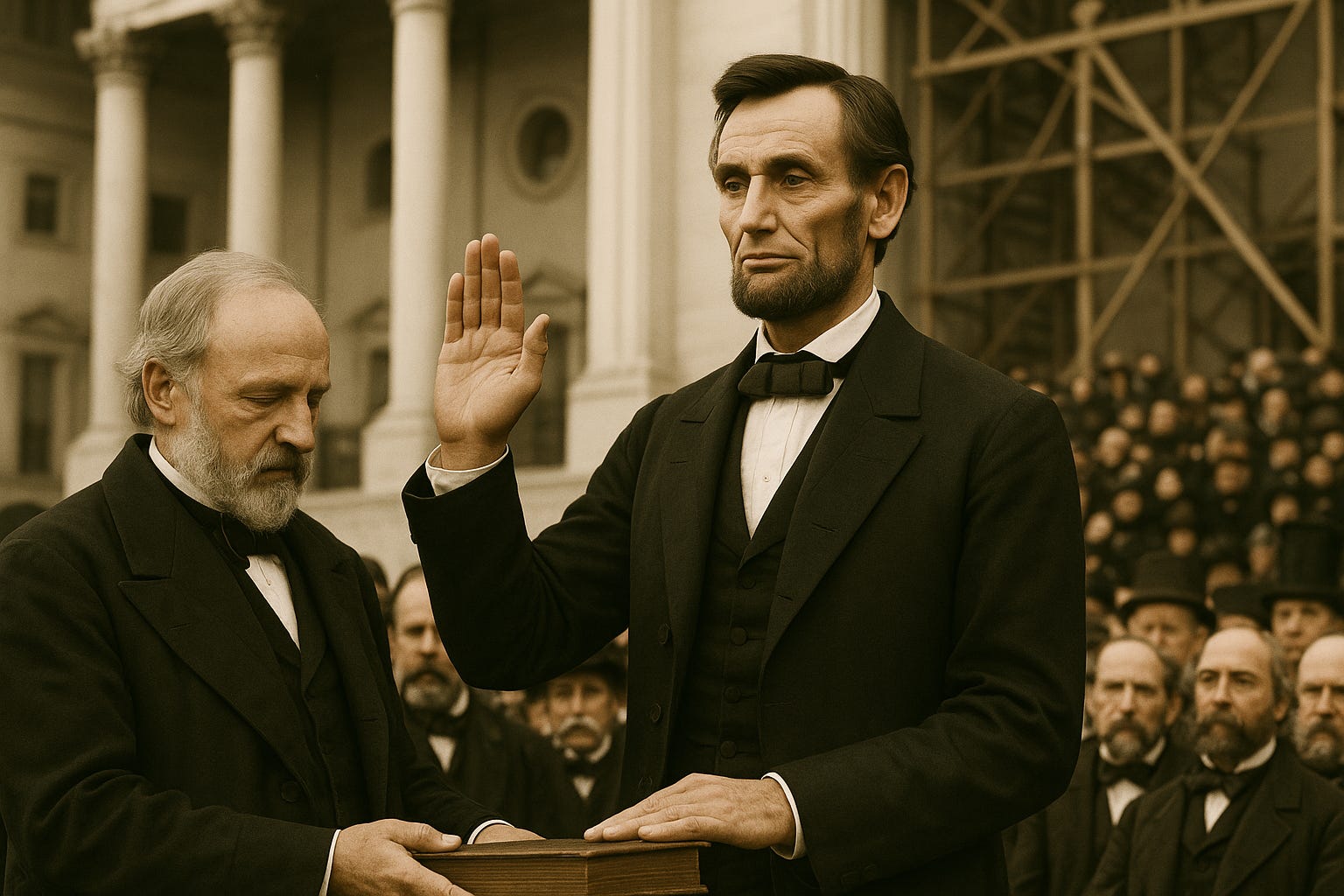
The Continuity Clause is the core of American constitutional permanence, both in its historical form under the Executive Oath, and in its analytical reconstruction within United States Protocol. It unifies three themes: the strength of the Union’s continuity, the Declaration of Independence as the original signal of sovereign consent, and the moral trigger condition for re-founding when governance fails its purpose. Together they show that continuity, the preservation of the constitutional order, is the highest command of the American system.
The Continuity Clause Defined
The Continuity Clause arises from Article II, Section 1, Clause 8 of the Constitution, where the President swears an oath is to “preserve, protect, and defend the Constitution of the United States.” This oath embodies the custodial function of sovereignty, the duty to maintain the Union’s existence and integrity in every circumstance.
In United States Protocol terms, this principle appears as US-EXE-001, the Continuity Clause or Executive Oath Function. The Executive acts as the guardian validator of last resort, ensuring the Union’s endurance through every challenge. All other continuity functions—legislative, judicial, military, and civic—emanate from this clause.
The President’s oath stands apart because it carries an active duty of preservation. Legislators and judges pledge to support the Constitution; the Executive is charged to defend it. This makes the President the living safeguard of constitutional order.
Historically, this role is exemplified by Abraham Lincoln, who preserved the Union in its greatest trial. The Executive Oath, therefore, serves as the Constitution’s heartbeat, a perpetual command to keep the system alive through any crisis.
Continuity as Constitutional Structure
The Framers built the Constitution on the assumption of perpetuity. They perfected a Union already declared perpetual under the Articles of Confederation and ratified it through “We the People,” creating one sovereign body. The design affirms enduring unity at the level of the people themselves.
Under United States Protocol modeling, this permanence becomes Continuity of the Union, the perpetuity invariant that the Executive’s oath protects when the Union’s integrity is threatened.
The Declaration of Independence as Genesis Signal
Every act of continuity presumes an origin, the first broadcast of sovereignty. That signal was the Declaration of Independence. It announced that legitimate power springs from the consent of the governed and that government exists to secure inherent rights. In United States Protocol terms, the Declaration is the genesis signal, establishing the purpose, validation rule, and objective of American governance.
Its structure maps naturally to United States Protocol logic. The opening statement of unity serves as the node-genesis event.
“When in the Course of human events, it becomes necessary for one people to dissolve the political bands which have connected them with another, and to assume among the powers of the earth, the separate and equal station to which the Laws of Nature and of Nature’s God entitle them, a decent respect to the opinions of mankind requires that they should declare the causes which impel them to the separation.
We hold these truths to be self-evident, that all men are created equal, that they are endowed by their Creator with certain unalienable Rights, that among these are Life, Liberty and the pursuit of Happiness.
—That to secure these rights, Governments are instituted among Men, deriving their just powers from the consent of the governed,—
That whenever any Form of Government becomes destructive of these ends, it is the Right of the People to alter or to abolish it, and to institute new Government, laying its foundation on such principles and organizing its powers in such form, as to them shall seem most likely to effect their Safety and Happiness.
Prudence, indeed, will dictate that Governments long established should not be changed for light and transient causes; and accordingly all experience hath shewn, that mankind are more disposed to suffer, while evils are sufferable, than to right themselves by abolishing the forms to which they are accustomed.
But when a long train of abuses and usurpations, pursuing invariably the same Object evinces a design to reduce them under absolute Despotism, it is their right, it is their duty, to throw off such Government, and to provide new Guards for their future security.”
The assertion that governments derive “just powers from the consent of the governed” defines the validation rule. The phrase “to secure these rights” expresses the system’s objective. The warning that government may become destructive of those ends identifies the reboot condition. And the closing pledge of mutual commitment provides the collective attestation anchoring the founding block.
The Declaration articulates why government exists; the Constitution implements how it operates. The Declaration’s moral signal continues as a living reference, while the Constitution channels it through lawful mechanisms. United States Protocol serves as the continuity layer synchronizing the two through time.
The Constitutionality of Secession
From the beginning, the United States was conceived as an indissoluble Union. Article XIII of the Articles of Confederation proclaimed that perpetuity, and the Constitution reinforced it. Ratification merged local sovereignties into one national people; the Constitution governs individuals directly, expressing the sovereignty of the whole.
The text offers clear affirmation of unity. Article V authorizes amendment to adapt the system; Article VI’s Supremacy Clause ensures national coherence; the Executive Oath secures defense of the entire constitutional framework. Every provision supports the Union’s continuity.
When rebellion threatened that order, Lincoln’s leadership upheld it, and the Supreme Court confirmed the principle in Texas v. White (1869):
“The Constitution, in all its provisions, looks to an indestructible Union composed of indestructible States.”
Federalism divides functions, never sovereignty. The People of the United States possess that sovereignty and may reshape governance through election and amendment.
The Continuity Clause therefore represents the living commitment of the Executive to preserve the constitutional whole, the guardian validator of last resort whenever the Union’s existence is questioned.
The Continuity Architecture of United States Protocol
United States Protocol renders this philosophy into a living architecture of governance:
Foundational Sovereignty: defines the perpetual Union, the perpetuity invariant.
Executive: enforces the Continuity Clause as guardian validator of last resort.
Legislative: codifies and funds continuity through law.
Judicial: interprets all law within one sovereignty, maintaining coherence.
Military: provides lawful defense under civilian command.
Citizen Layer: expresses ongoing consent through civic participation and allegiance.
These six layers form the Continuity Group, a self-healing loop of Preserve → Codify → Validate → Re-consent. In this design, the Union functions as a single live system. Every action of governance affirms continuity and reinforces the sovereign whole.
The Trigger Condition and Lawful Reboot
Jefferson’s Declaration recognized that when a government fails to secure rights, the people may alter or abolish it. This right is moral rather than procedural, a safeguard for human liberty that exists beyond written law. The Constitution, designed for endurance, embeds peaceful self-repair mechanisms instead of self-destruction.
The American system offers ascending layers of renewal:
Routine repairs through elections, petitions, and a free press refresh consent.
Structural reforms under Article V amend the system’s core code while preserving identity.
Emergency procedures such as impeachment, succession, and judicial review remove corruption without endangering order.
Meta-structural renewal through conventions or national ratification allows collective reaffirmation of the social contract.
Only when all lawful routes are closed and consent itself becomes impossible does the Declaration’s ultimate right of re-founding awaken. In United States Protocol terms, this event lies outside normal operation, the meta-constitutional reset of popular sovereignty.
A soft reboot restores continuity through legal correction. A hard reboot occurs when the People, acting as the original validators, issue a new genesis signal—a declaration, convention, and re-ratification that renew the constitutional chain as a whole. Such re-founding recreates legitimacy through consent and design.
The Continuity Clause as Moral Constraint
The Continuity Clause balances stability and renewal. It sustains lawful continuity until prudence, necessity, and unity align for deliberate reform. In doing so, it guards both order and human agency, protecting the system from collapse while reserving to the People the right of collective re-creation.
By ensuring the Constitution endures until a new consensus arises, the Clause transforms duty into permanence. Governance persists so that liberty may always find lawful expression.
Continuity in Practice
Every branch and layer contributes to this architecture of preservation:
The Executive preserves integrity and initiates defense when needed.
The Legislature provides the legal and fiscal instruments of continuity.
The Judiciary ensures every judgment reflects one sovereignty.
The Military defends constitutional order under civilian command.
The Citizenry renews legitimacy through participation and allegiance.
Together they make the Union resilient against failure. Continuity functions because each component upholds the others.
The Perpetual Mandate
The Continuity Clause is the heart of American constitutional life. It unites the Executive’s oath, the Union’s perpetuity, and the People’s enduring consent. Within both the Constitution and United States Protocol:
The Union endures as a single sovereign organism.
The President serves as guardian pledged to its preservation.
The People hold the ultimate power to renew that Union collectively through consent and principle.
Continuity is the essence of American self-government, an affirmation, not a limitation. The Union endures by right, by law, and by design.
The American Union was born of conviction, a deliberate act of reason and faith in self-government. Its continuity is the living proof that liberty can be bound to law without surrendering to decay. The same People who once assumed “among the powers of the earth” their equal station now sustain that assumption through institutions that preserve, protect, and defend it across generations.
The Continuity Clause stands as their oath in motion, the guardian of that original signal, ensuring that the republic endures by fidelity to first principles. So long as consent is renewed, truth upheld, and duty kept, the Union remains what it was meant to be—one people, perpetually free, perpetually responsible, perpetually united.
At United States Lab, we are implementing the United States Constitution’s compound republic governance model in web3. If you are interested in this research, please follow our R&D work.