


A Protocol, If You Can Implement It
United States Lab reconstructs the interdependent design of U.S. Constitutional governance using the language and primitives of blockchain-based and DAO governance systems. By disaggregating the U.S. system into formal governance primitives—such as rulemaking, execution, validation, civic signaling, and apportionment—the United States Lab framework re-engineers the American compound republic into a digital governance stack. We map each constitutional feature to its functional analog in protocol design: from bicameral deliberation to validator rotation, from veto thresholds to ZK-proof civic signaling. The result is a rigorously layered system of checks, filters, and role constraints intended for implementation in distributed and decentralized architectures.
Engineering the U.S. Constitution in Parallel Systems
The United States Constitution is a design blueprint for distributing power, mitigating capture, and engineering consent. United States Lab treats the U.S. system as an executable governance model: one that can be encoded, mapped, and restructured across decentralized platforms.
United States Lab translates the Constitution into blockchain-native governance primitives: validator configurations, execution thresholds, proposal gating, apportionment logic, and civic identity proofs. In doing so, United States Lab enables a parallel civic infrastructure—one capable of reflecting, evaluating, and eventually stewarding real-world constitutional processes.
Mapping Constitutional Functions to DAO Primitives
United States Lab identifies a set of core constitutional functions and maps them to their corresponding governance primitives in blockchain-based and DAO systems. Each pairing below reflects a formal analog intended for system design:
Bicameral Legislature: Reconstructed in the United States Lab model as a dual-layer governance system, combining a Civic Signaling Layer (1 Person 1 Vote) with a Weighted or Constitutional Execution Layer to simulate the balance between popular will and state sovereignty.
Executive Veto: Modeled in United States Lab as a singular veto authority—mirroring the U.S. President—who can unilaterally block execution without requiring consensus. This is implemented through a unique validator role or ZK-veto credential that carries unilateral blocking authority. In contrast, multisig councils or constitutional veto committees represent collective veto mechanisms that are separately defined. The United States Lab model ensures that singular and collective veto powers are structurally distinct, preserving the integrity of the executive function as constitutionally constrained but independent.
Judicial Review: Paralleled in United States Lab via validator challenge layers, rotating credentialed review bodies, and procedural attestation systems that enforce legitimacy on state transitions, functioning as a rotating, credential-bound validator cohort that enforces procedural validity and constraint—analogous to a decentralized constitutional court.
Electoral College / District Apportionment: Modeled with zero-knowledge-based district-weighted voting systems, which preserve proportionality and jurisdictional representation while protecting privacy and preventing sybil attacks.
Bill of Rights: Represented in protocol form through constraints on execution boundaries, permissionless participation rules, and baseline procedural protections encoded at the protocol level.
These mappings are foundational to the United States Lab architecture. They are not abstract comparisons but structural rulesets that inform constraint logic, governance thresholds, and validator eligibility in the protocol stack. The result is a system where each constitutional function is reimagined as an enforceable, modular, and verifiable primitive for decentralized use.
Layered Interdependence in the United States Lab Stack
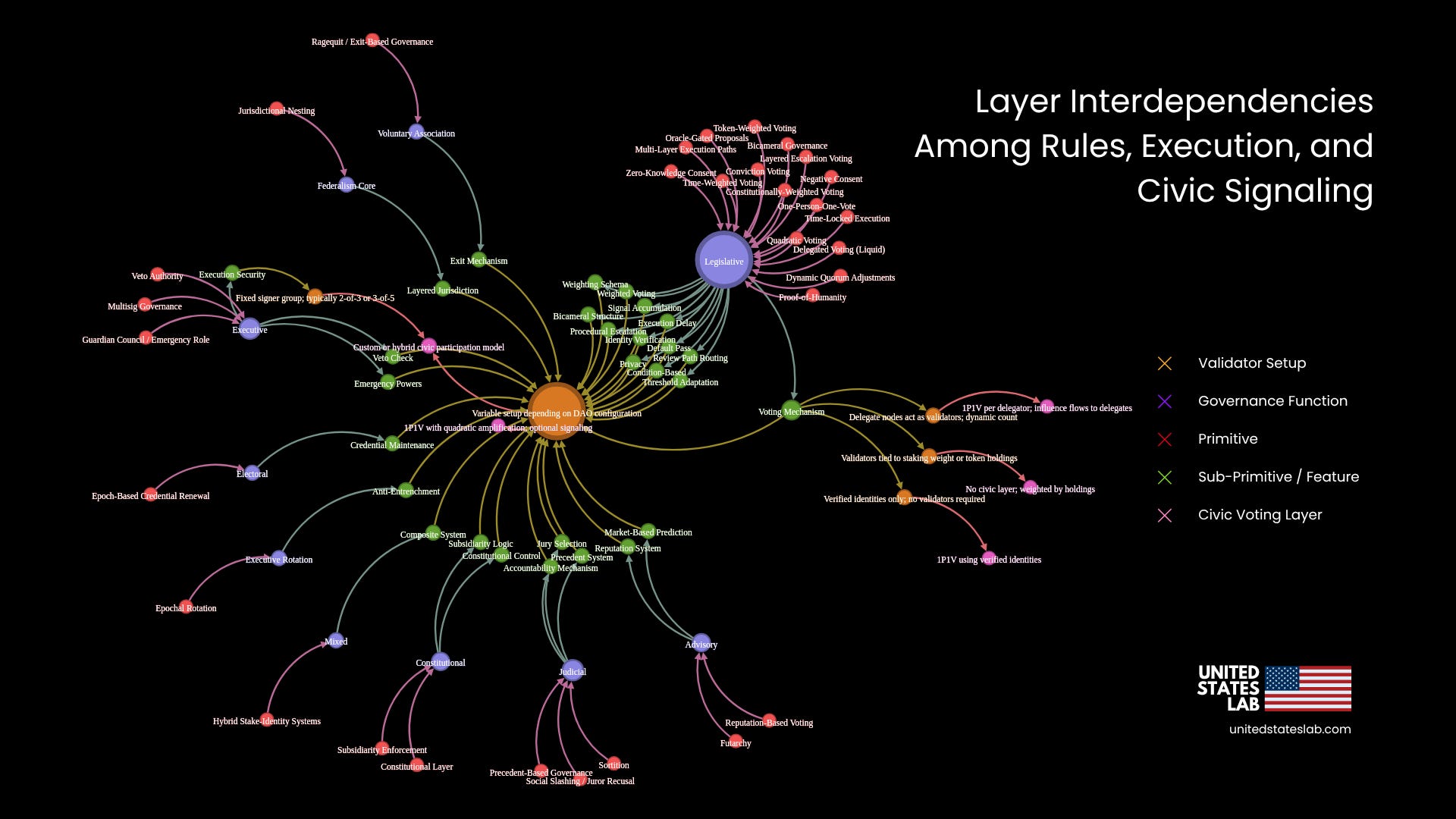
The radial force-directed graph accompanying this article visually depicts these interdependencies across layers and mechanism types. Each node represents a constitutional primitive or governance component reinterpreted through the United States Lab model. Node types are color-coded by role: primitives, validator setups, governance functions, civic voting layers, and sub-primitives or features.
The central hub in the diagram represents a placeholder execution node—Variable setup depending on DAO configuration—surrounded by dependencies and upward delegations. For example, the Legislative layer branches outward to reveal rule origination primitives such as Token-Weighted Voting, One-Person-One-Vote, Quadratic Voting, and Delegated Voting, all categorized under governance functions like Voting Mechanism or Constitutional Weighting.
Validator-related mechanisms like Multisig Governance, Juror Rotation, and Guardian Councils are tied to execution and emergency roles. Civic signaling flows outward from mechanisms like 1P1V verified identity systems, ZK credential layers, and jurisdictional apportionment primitives.
Importantly, the visualization shows how no single function or role is standalone; instead, they are connected by colored directional links that trace delegation, dependency, or constraint. These ties encode the same foundational logic as the U.S. Constitution: checks, balances, layered validation, and civic consent.
In the United States Lab model, governance layers are structured explicitly to reflect constitutional interdependence:
Legislative Layer → Rule Origination: Proposals enter through verified civic intent. 1P1V chambers capture popular will. Weighted or Constitutional Execution Layers simulate district influence.
Execution Layer → Constrained Action: No execution may occur without meeting threshold approval and timing criteria (veto delay, veto override, executive quorum).
Validation Layer → Procedural Legitimacy: Each state transition or proposal pass-through must be checked by verifiable validators (rotating, attested, or recusable).
Civic Layer → Consent and Filtering: Verified human actors, district attribution, and digital suffrage proofs anchor legitimacy.
This stack is visually rendered as a radial interdependency graph, reinforcing the constitutional logic that no layer operates independently.
Civic Signaling and Zero-Knowledge Participation
Credential Onboarding and Access: Each citizen begins by completing a privacy-preserving credentialing process to prove eligibility—such as U.S. citizenship and district residency—via zero-knowledge proof mechanisms. This step produces a civic credential that can be used for signaling, voting, or representation within the appropriate jurisdictional layer. Unlike token-weighted systems that assume stake equals legitimacy, the United States Lab model encodes suffrage and civic legitimacy through cryptographically verifiable and structurally apportioned mechanisms of participation.
Zero-Knowledge Verified Citizenship or District Credential: Each participant in the civic governance layer must generate ZK proofs of civic eligibility, such as verified citizenship, residence within a constitutional jurisdiction, or age threshold satisfaction. These credentials are tied to a district-based apportionment model that mirrors the U.S. electoral framework while preserving privacy.
Layered Signaling Structures: Civic signaling operates at multiple temporal and functional layers. Participants may signal frequent intent (preferred policy direction, proposed representative support) and episodic participation (referenda, elections, procedural challenges). The protocol logs these as attestations and aggregates them in verifiable ways.
Dual-Apportionment: Proposals and participation are processed through a bicameral logic structure. The Civic Signaling Layer reflects 1P1V equality among all credentialed citizens, while the Constitutional Execution Layer introduces structural weighting—by district, jurisdiction, or identity cohort. Together, these layers mirror the House and Senate dynamic: one apportioned by population, the other by federated jurisdiction.
Preventing Plutocracy and Ensuring Expression: By avoiding both plutocratic stake-based models and simplistic 1P1V-without-verification schemes, United States Lab ensures that civic input is both expressive and filtered—maximizing signal fidelity while minimizing sybil and capital distortion.
Signaling Infrastructure: Participation in the Civic Signaling Layer involves cryptographically signed messages or ZK-attested ballots. These may be used to influence weighted deliberation, trigger proposal slots, or issue recalls or challenges to DAO executors or validators. The signaling layer is designed to be durable, censorship-resistant, and accessible via secure frontends.
In effect, United States Lab’s civic signaling design is not simply a voting tool—it is a distributed constitutional suffrage system, one that enables governance participation to scale without abandoning the structural logic of the republic it emulates.
Execution: Delay, Veto, and Structural Restraint
Execution in the United States Lab model is not an initiating power. It is a controlled downstream function that must satisfy a strict series of layered prerequisites. These include:
Temporal Epochs and Role Duration: All validator and veto-authorized roles operate within defined term limits or governance epochs. These temporal boundaries ensure that no authority persists indefinitely and that civic oversight may reset or reauthorize governance actors at regular intervals.
Civic Filter Completion: Before any proposal reaches execution, it must pass through a 1P1V Civic Signaling Layer, verified identity checks, and any jurisdictional apportionment thresholds. This ensures legitimacy and rule alignment before activation.
Quorum Satisfaction: Execution is gated by quorum thresholds not just in terms of voter turnout but in compositional structure—minimum participation by district, validator class, or chamber.
Timed Execution Delay: Each proposal is assigned a risk-weighted delay class. Lower-risk procedural proposals (budget disbursements, etc.) may have minimal delay. Higher-risk proposals (rule changes, validator replacement, etc.) are delayed longer and require time-based challenge windows.
Veto Authority Windows: Execution cannot proceed until the expiration or successful override of a veto delay. The veto mechanism may be executed by a guardian multisig, rotating constitutional council, or a ZK-veto proof registered from a protected civic group (a constitutional council, validator minority bloc, or rotating civic credential class empowered with procedural standing similar to a Senate filibuster or judicial challenge).
DAO analogs include:
Guardian Multisigs: Reflecting the President’s capacity to act alone in vetoing legislation—where a single constitutional actor holds blocking authority—as well as collective structures like a constitutional council that share or distribute that power.
Timelocked Contracts: Hard delays enforced by smart contract timers.
Challenge Windows: Windows during which validators or credentialed minorities may raise a procedural objection.
Dynamic Risk-Based Execution Classes: Governance actions categorized by class, each with separate delay and oversight logic.
Validator Rotation, Recusal, and Attestation: Validators in United States Lab are not static. They are subject to:
Rotation Epochs: No validator retains indefinite authority.
Recusal Requirements: Validators must disclose and abstain when conflicts arise.
Credentialed Attestation: Validators sign execution eligibility using a known credential chain—proving they are qualified, current, and not colluding.
These mechanisms ensure that execution is structurally restrained, procedurally verified, and cryptographically accountable. Execution is deliberately staged behind concentric filters of civic legitimacy, risk analysis, and validator integrity.
System Design Principles of United States Lab
The United States Lab architecture implements a formal governance protocol that mirrors the U.S. Constitution’s layered logic using rigorously defined cryptographic mechanisms and governance primitives. It reflects the structure of a dual-layer governance system—composed of a Civic Signaling Layer and a Constitutional Execution Layer—intended to preserve both expressive participation and federated weight. Each principle described below functions as a required interlock, ensuring no actor or layer may dominate the process independently.
Layered Power Separation — The system enforces a strict architectural rule: no actor, validator class, or representative group may possess overlapping control across governance origination, execution, and validation layers. Proposers cannot execute, validators cannot initiate policy, and executors cannot bypass attestation. This separation ensures that rulemaking is structurally distinct from enforcement.
Civic Filtering — Every governance action, whether originating from a proposal or culminating in execution, must pass through verifiable civic checks. These checks include ZK-proof credential attestations, district membership verifications, and account age or participation history. Civic filtering guarantees that proposals originate from eligible participants and that participation reflects qualified suffrage.
Apportionment Logic — Inspired by the U.S. House and Senate model, all vote weighting follows a dual-apportionment logic. The Civic Signaling Layer registers equal voice per eligible participant, while the Constitutional Execution Layer reflects structured jurisdictional influence. This prevents raw capital from controlling governance outcomes and ensures constitutional proportionality is preserved.
Validator Discipline — Validators are bound by procedural discipline. Each validator must undergo regular rotation epochs, prove continued credential status, and submit to recusal protocols if conflicts are detected. Additional requirements may include attestation from peers, participation records, and jurisdictional rotation to prevent cartelization.
Execution Constraint — Execution pathways are safeguarded through layered constraint mechanisms. Proposals are routed through delay queues, veto challenge windows, and approval thresholds tied to risk classes. Governance is structured to delay or halt execution if procedural irregularities arise or if minority veto triggers are engaged. Recourse includes rollback votes, challenge elections, and elevated validator quorum reviews.
United States Lab also supports structured amendment and termination logic. Proposals to alter core governance mechanisms must pass elevated thresholds, undergo district-level challenge windows, and may trigger protocol referenda before final implementation. This ensures that the system remains adaptable while preserving constitutional constraints. United States Lab’s model distributes procedural power through credentialed suffrage, federated apportionment, and non-financial governance thresholds.
This architecture is derived directly from the live-tested constitutional compound republic. What the Constitution expresses in checks and balances, United States Lab operationalizes through formalized constraints and enforcement logic at the protocol layer.
Encoding a Constitutional Order
Through its framework of written constraints and federated delegation, the U.S. Constitution establishes a distributed system of power. United States Lab mirrors this logic using circuits, proofs, and modular governance primitives. Both systems enforce legitimacy by refusing to concentrate unchecked power. In both, no single actor owns the stack—rulemaking, execution, and validation are not only separated, but interdependently enforced.
This layered interdependence is visible in the radial graph accompanying this article. That visualization, built from the United States Lab governance taxonomy, shows how primitives such as 1P1V civic signaling, veto-capable execution delay, validator rotation, and jurisdictional apportionment are structurally tied together. The graph reveals that every core function of governance is anchored to another, forming a mesh of constraint.
Consider the civic layer. Participation isn’t just about casting a vote—it involves passing ZK verification, proving jurisdictional alignment, and entering a signaling pathway that aggregates into weighted governance. This mirrors the logic of apportionment in the U.S. House and Senate. Similarly, validator functions are constrained by rotation and recusal, proving that procedural legitimacy is not implicit, but actively maintained.
Rule proposals are routed through both 1P1V and apportioned filters, then delayed, checked, and only then executed—if no veto or procedural challenge intervenes. This mimics the legislative process of bicameralism, presidential veto, and judicial review in operational logic.
As adoption of the system increases, a tipping point may emerge wherein candidates for real-world public office—wishing to demonstrate transparency, constitutional literacy, and alignment with their constituency—begin using the United States Lab system themselves. In doing so, they would not only signal their intent and proposals with cryptographic legitimacy, but could also invite their constituents into a more verifiable civic relationship. Over time, such candidates—being both citizens and credentialed district participants—could be elevated to multisig roles in the execution layer of the system, participating directly in the constitutional enforcement of the governance protocol, if and when it is fully codified and accepted as an operating civic framework.
In sum, the United States Lab model is not simply inspired by the U.S. Constitution—it is a faithful functional decomposition. It treats the republic as an executable governance protocol. United States Lab offers a provable model: a republic of logic, engineered to restrain power, enforce procedure, and verify consent, and grounded in the structural logic of the U.S. Constitution.
At United States Lab, we are implementing the United States Constitution's compound republic governance model in web3. If you are interested in this research, please follow our R&D work.