


A Republic, If You Can Encode It
The accelerating evolution of blockchain technology and decentralized governance has brought forward a need for more principled systems of legitimacy and structure. As various Decentralized Autonomous Organizations (DAOs) experiment with novel mechanisms for decision-making, representation, and enforcement, one thing becomes clear—governance innovation is not about novelty alone; it is about mapping foundational principles to digital systems that can scale across jurisdictions and generations.
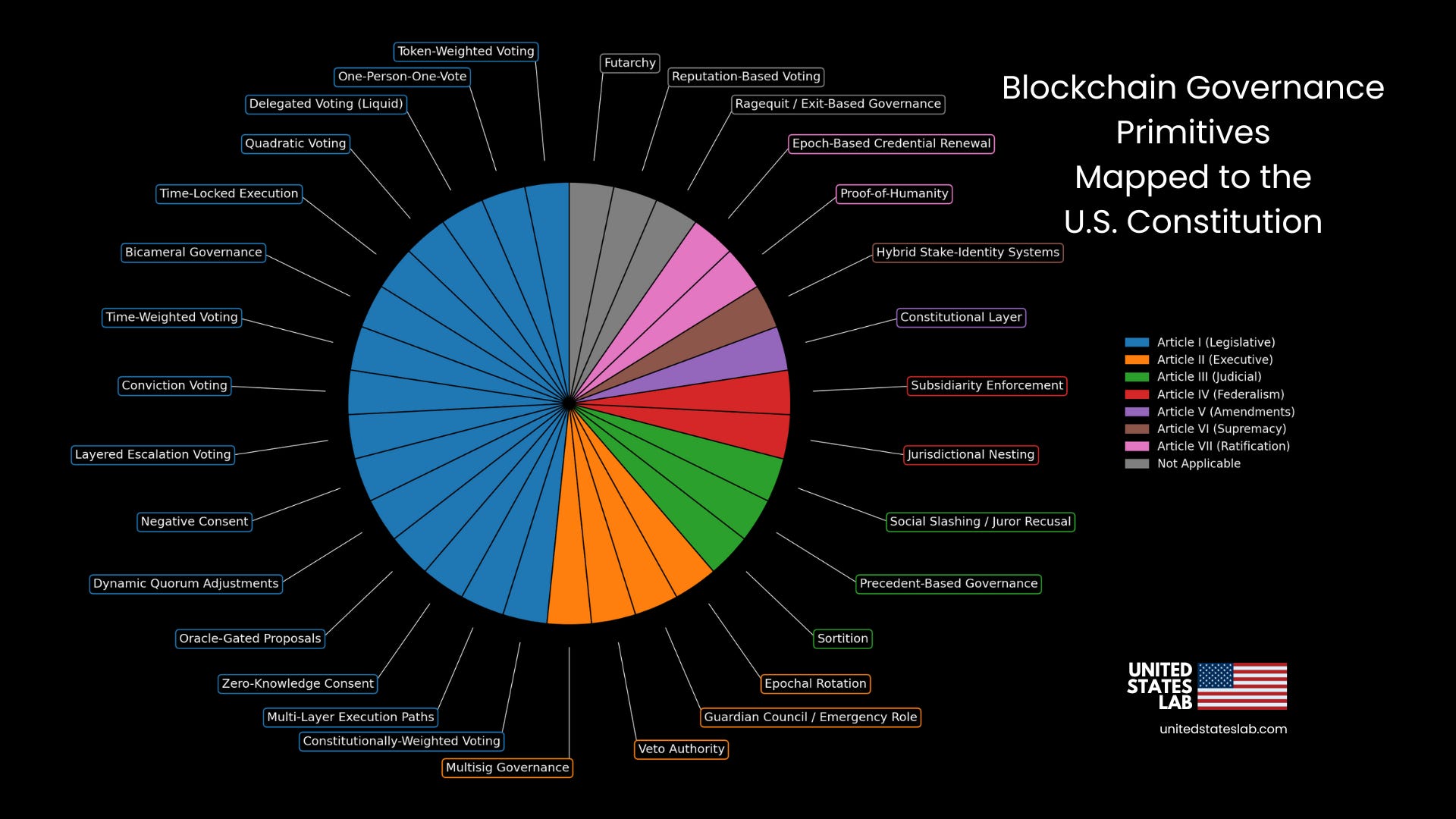
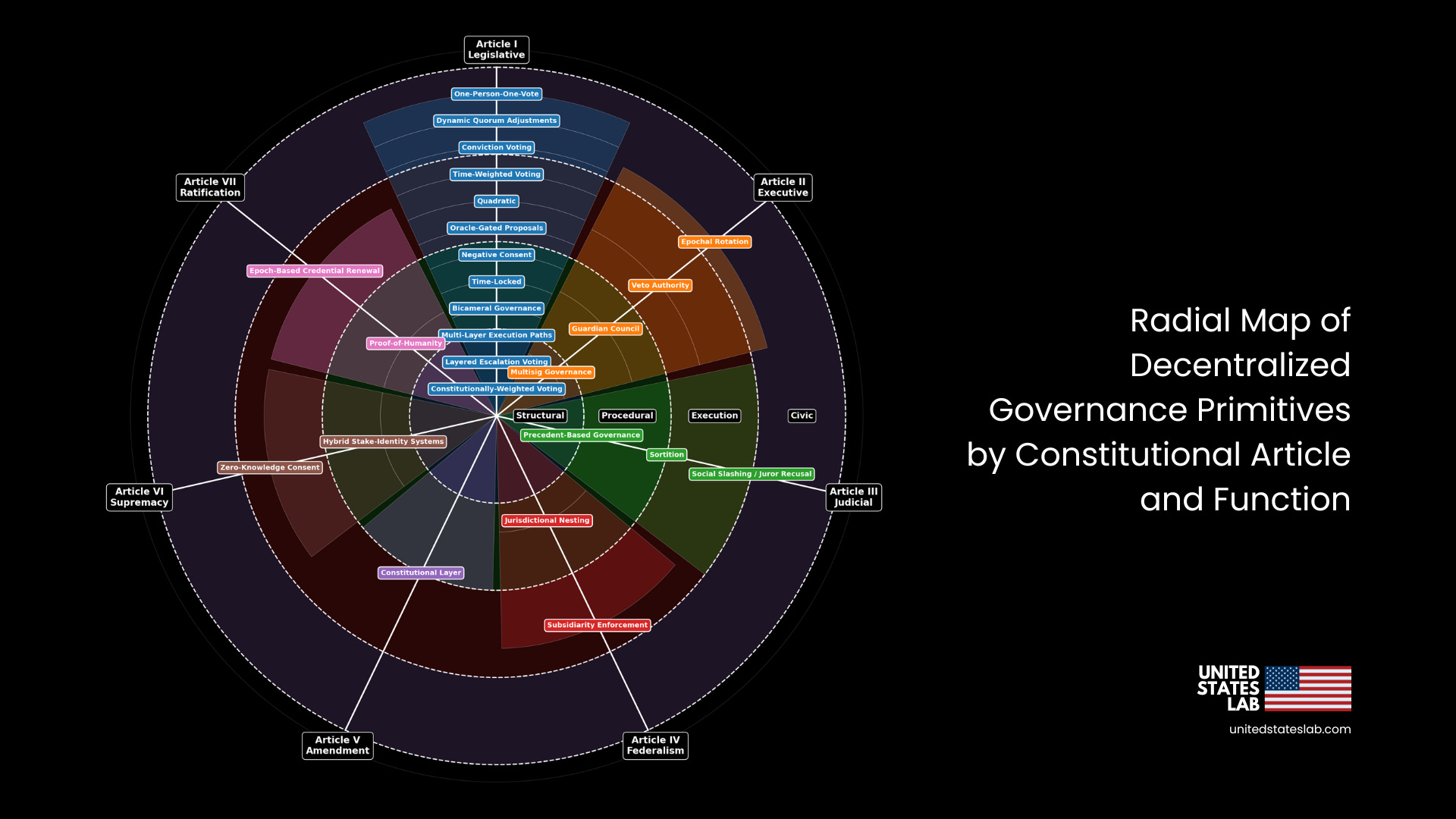
This article explores how known blockchain governance primitives align with the Articles of the U.S. Constitution, a document that has preserved distributed legitimacy across a federal Union for two and a half centuries. The visual chart categorizes each governance mechanism by its constitutional analog, cryptographic underpinnings, operational layer, and systemic role.
The Layered Constitutional Framework
Each governance primitive was mapped to one or more of the seven Articles of the Constitution, illustrating how decentralized systems can embrace the wisdom of polycentric, constrained authority.
Article I — Legislative
Aligns with mechanisms like Bicameral Governance, Token-Weighted Voting as a cautionary tale, Time-Locked Execution, Multi-Layer Proposal Paths, and Constitutionally-Weighted Voting. These mechanisms define how law is proposed, filtered, and ratified.
Article II — Executive
Includes Multisig Governance, Guardian Councils, Epochal Rotation, and Veto Authority. These serve the role of enforcement, emergency override, and executive restraint.
Article III — Judicial
Encompasses Precedent-Based Governance, Sortition (for citizen juries), and Social Slashing or Juror Recusal—tools for legal interpretation, arbitration, and adjudication.
Article IV — Federalism
Reflects Jurisdictional Nesting and Subsidiarity Enforcement primitives, ensuring that sovereignty and decision-making authority remain at the most local feasible level.
Article V — Amendments
Maps to Constitutional Layers—immutable or slow-changing root-level rules governing all other logic.
Article VI — Supremacy Clause
Is best mirrored by systems like Hybrid Stake-Identity Governance, where identity-verification overlays elite or token-based power with constitutional legitimacy.
Article VII — Ratification
Resonates with Proof-of-Humanity and Epochal Credential Renewal—tools that ensure participants remain continually verified and bound by social contract.
Constitutional Functions Reflected in Governance Safeguards
Each governance primitive can be further understood through the lens of structural safeguards—design features that reflect the constitutional logic of restraint, distribution of power, and durable legitimacy.
Privacy-Preserving Consent
Systems that allow individuals to participate in decision-making without exposing their identities or votes publicly echo the secret ballot and the importance of uninhibited civic expression. These safeguards ensure that public pressure or surveillance cannot distort the free will of participants.
Shared Executive Control
Decision-making protocols that require multiple actors to jointly approve critical actions mirror the constrained executive powers in the U.S. Constitution, such as the President's need for Senate confirmation. These roles are useful in emergency procedures or fiduciary actions, ensuring no single individual has unilateral authority.
Conditional Activation Mechanisms
Just as real-world laws may include triggers or contingencies, such as presidential war powers activated under threat, governance systems can include conditional mechanisms that activate based on external inputs. These checks align with the constitutional principle that not all powers are always active—they are responsive to circumstance.
Term-Based and Credentialed Participation
Structures that require participants to renew their credentials, confirm their identity, or rotate out of governance roles echo constitutional commitments to term limits, elections, and civic accountability. These elements help prevent entrenchment and reinforce civic renewal.
Jurisdictional Scope Limitation
Some mechanisms enforce clear boundaries of authority, ensuring that decisions are only made by those empowered to do so. This mimics the federalist logic in the Constitution, where state and federal roles are deliberately separated and protected.
Consensus Delays and Objection Windows
Features like time-locked decisions and objection windows reflect the role of deliberation and veto in constitutional systems. They provide time for stakeholders to review decisions and raise concerns, echoing legislative filibusters or executive vetoes.
These safeguards, while implemented in various forms, ultimately serve the same function as constitutional checks and balances—to make the exercise of power legitimate, reversible, and accountable across time and scale.
Design Considerations for the United States Lab Ecosystem
From the mapping exercise, a distinct set of blockchain governance primitives emerge as especially well-suited to United States Lab's compound republic model. These are mechanisms that reflect the structural priorities of the U.S. Constitution—federalism, checks and balances, layered sovereignty, and participatory legitimacy.
At the highest tier of alignment are those with very high applicability. These include Bicameral Governance, which mirrors the House-Senate structure; Jurisdictional Nesting, which reflects the balance between state and federal authority; and Precedent-Based Governance, which emulates the role of judicial interpretation. Constitutional Layer mechanisms embody the spirit of Article V by establishing meta-governance rules that are difficult to change. The Executive Veto is also represented through Veto Authority, while Zero-Knowledge Consent and Constitutionally-Weighted Voting align closely with the principles of privacy, identity, and representation that underpin legitimate democratic processes.
A second group of mechanisms demonstrates high applicability. These include One-Person-One-Vote, made viable through zkID-based sybil resistance, and Guardian Councils or Emergency Powers that parallel constitutional executive overrides. Proof-of-Humanity and Epoch-Based Credential Renewal ensure participants are continually verified, just as citizenship and civic re-engagement are foundational to constitutional participation. Sortition and Multi-Layer Execution Paths offer mechanisms for randomized representation and layered review, reflecting elements of jury service, legislative committees, and escalatory oversight.
Taken together, these tools represent a toolkit not only for technical innovation, but for institutional resilience. They are the primitives that most faithfully carry forward the founding architecture of the United States into the domain of polycentric, decentralized digital governance.
A Constitutional Standard for Digital Governance
Governance is not just a technology problem, it is a legitimacy problem. By rooting digital governance systems in the logic of the U.S. Constitution, we not only extend that logic into the next era of human civilization, we encode our shared principles into systems of power that cannot as easily or incrementally become corrupted.
United States Lab will continue to refine its constitutional framework, integrating zero-knowledge proofs, soulbound credentials, and federated sovereignty into a scalable civic infrastructure.
This visual map is a living document—a constitutionally informed starting point for what comes next.
At United States Lab, we are implementing the United States Constitution's compound republic governance model in web3. If you are interested in this research, please follow our R&D work.