


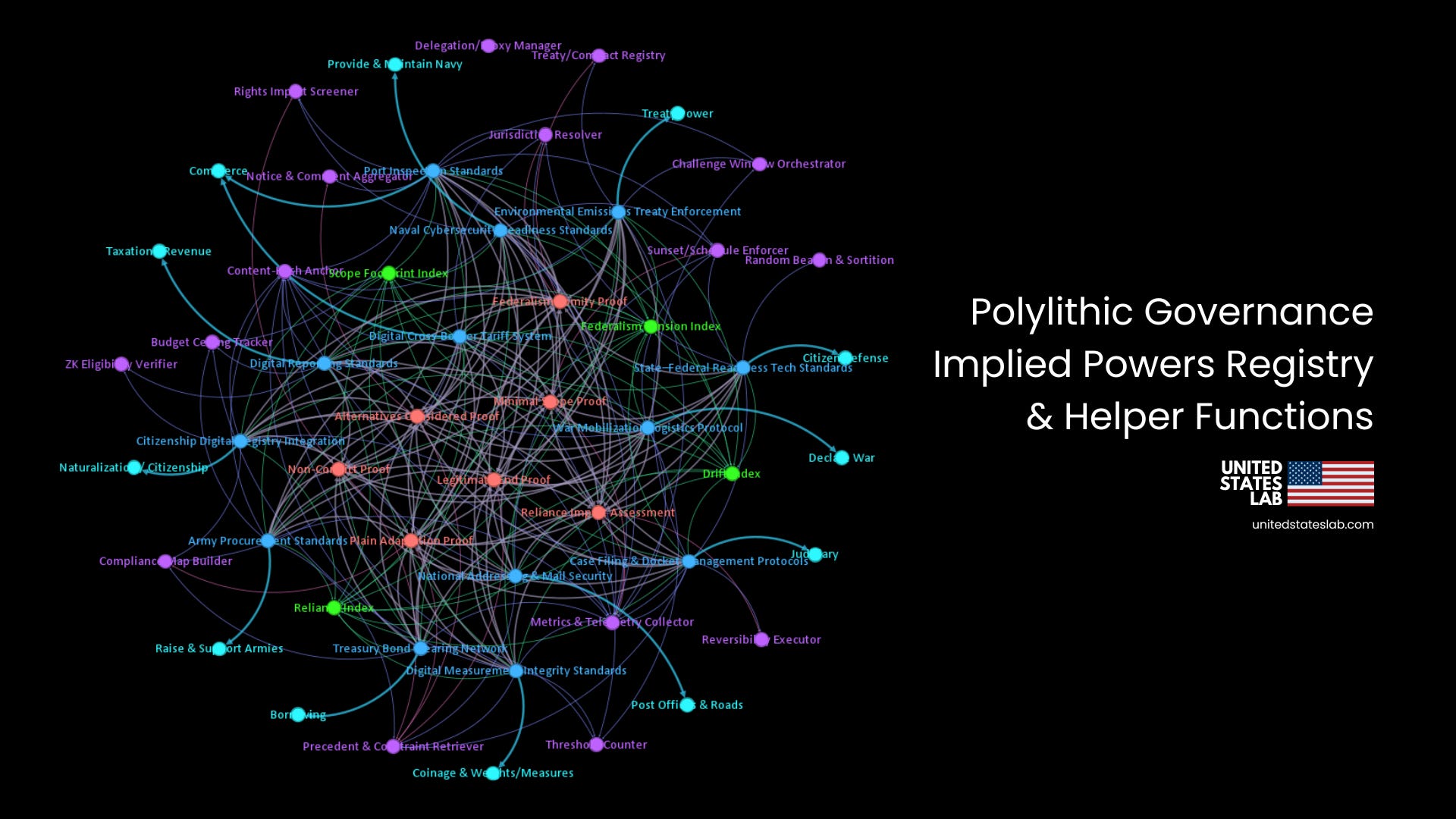
The United States Constitution carefully enumerates the powers of Congress and the Executive, but from the beginning, debate has swirled around how those powers are actually carried out. On one hand, enumerated powers define the scope of federal authority. On the other, real-world governance requires derivative capabilities not spelled out in the text.
In United States Protocol, these derivative capabilities are modeled as Implied Powers and Helper Functions, two categories that allow execution to scale while preserving Madison’s compound republic framework of limits, checks, and distributed authority.
United States Protocol places these tools within a structured framework, allowing society to harness the necessary flexibility to govern without falling into the dangers of arbitrary expansion. The balance struck here is to create capacity while preserving the legitimacy of a constitutional republic.
Historical Grounding
The question of implied powers is as old as the republic itself. Alexander Hamilton argued for a broad reading of the Necessary and Proper Clause, while James Madison and Thomas Jefferson urged strict boundaries to prevent drift into consolidation. Federalist No. 44 (authored by Madison) acknowledges the necessity of implied powers, but insists they must remain tethered to explicit grants. The United States Protocol model inherits this tension; flexibility is required, but constraint is paramount.
This historical foundation highlights that United States Protocol is an evolution of the Founders’ own debates. By embedding checks directly into the governance engine, the model answers questions Madison and Hamilton left unresolved with tools fit for modern execution.
From Enumerated Powers to Executable Governance
Enumerated powers establish the baseline authority of government, but their text alone cannot account for the countless operational details required to govern. To move from broad constitutional statements to functioning execution, derivative and supportive structures must exist.
Enumerated Power (EP): A direct constitutional authority, such as the Commerce Clause or the Coinage Power.
Implied Power (IP): A derivative authority tethered to a specific EP, justified by necessity, scope, and proportionality.
Helper Function (HF): A utility routine that enforces process and reduces implementation risk. It never carries authority on its own.
This architecture ensures that capability flows only from explicit constitutional roots, while operational complexity is handled by reusable, non-authoritative functions.
By distinguishing between these three levels—enumerated, implied, and helper—United States Protocol guarantees clarity of role. Powers flow from the Constitution, while functions provide the technical means, ensuring the line between authority and execution never blurs.
Implied Powers Matter
Governments cannot anticipate every operational need in the text of a constitution. Implied powers fill this gap, providing derivative authority so that enumerated clauses can actually function. Without them, governance would stall at every unforeseen detail.
Implied Powers allow governance to adapt without rewriting the Constitution every time conditions change. For example, the Commerce Clause does not mention port inspection standards, yet enforcing safe trade requires them. In United States Protocol, these implied authorities exist only when bound to a parent clause and proven through a Constraint Proof Bundle (CPB).
Safeguards Built In
Derivation Checks: Every IP must prove it derives from a specific enumerated power.
Minimality: The least intrusive, effective means must be chosen.
Constraint Proofs: Necessity, proportionality, federalism, civil liberties, budget compliance, and temporal limits are all tested before execution.
Execution Tokens: Approved IPs are granted limited, auditable authority with clear expiry and revocation paths.
This prevents implied powers from becoming an open-ended license.
By tightly bounding derivative authority, United States Protocol turns implied powers into trusted instruments rather than threats to liberty. The model transforms a once-dangerous ambiguity into a clearly supervised and verifiable capability.
Lifecycle of an Implied Power
The path from intent to execution is carefully staged so that no implied authority can slip through without validation.
Proposal: Draft an Implied Power Contract (IPC) with enumerated anchor, scope, proofs, and doctrinal references.
Validation: Automated checks and reviewer attestations confirm legitimacy, plain adaptation, minimal scope, and non-conflict.
Activation: Triggered by the Necessary & Proper helper call with a challenge window.
Monitoring: Telemetry feeds measure Scope Footprint, Drift Index, Federalism Tension, and Reliance.
Renewal/Expiration: At the end of the epoch term, proofs are re-run with updated data.
Challenge & Adjudication: Citizen Challenge, suspension, reversal, and restitution if reversal occurs.
Taken together, this sequence shows how governance in United States Protocol is not about unchecked execution, but about iterative validation. Every step reinforces that lawfulness is proven continuously, not assumed once.
Constraint Proof Bundle (CPB)
Every invocation of an implied power requires a CPB, which includes:
Legitimate End Proof: Demonstrates explicit tether to an enumerated power, citing the constitutional clause and showing the objective end pursued.
Plain Adaptation Proof: Shows that the proposed means is plainly adapted, useful, and fitting for the enumerated end without creating new authority.
Minimal Scope Proof: Defines boundaries that ensure the action is limited to what is necessary, with measurable and auditable limits.
Non-Conflict Proof: Confirms that the action does not conflict with constitutional prohibitions, reserved rights, or explicit text.
Federalism Comity Proof: Assesses respect for state sovereignty, cooperative federalism, and avoidance of undue preemption.
Alternatives Considered Proof: Documents other less intrusive or state-led options and explains why they are insufficient.
Reliance Impact Assessment: Anticipates who will depend on the implied power and creates a plan for transition if reversal or expiration occurs.
Together, these proofs ensure that no implied authority can be invoked without demonstrating its constitutional legitimacy and bounded scope.
The Constraint Proof Bundle turns what was once a matter of legal interpretation into a structured proof system. It forces every actor to show their work, ensuring transparency and limiting room for abuse.
Helper Function Catalog
Every governance system requires tools that are consistent and reusable. The Helper Function catalog ensures that complex decisions can always draw upon a common set of utilities.
Representative Helper Functions in United States Protocol include:
Jurisdiction Resolver: Directs disputes to the correct venue and resolves conflicts of law.
Notice & Comment Aggregator: Collects public input, timestamps submissions, and verifies quorum for deliberation.
Random Beacon & Sortition: Provides auditable randomness to seed citizen juror pools fairly.
ZK Eligibility Verifier: Confirms a citizen’s standing or eligibility through zero-knowledge proofs while preserving privacy.
Precedent & Constraint Retriever: Fetches relevant cases, past proofs, and doctrinal references for review.
Budget Ceiling Tracker: Validates funding sources, monitors ceilings, and enforces appropriation rules.
Challenge Window Orchestrator: Opens and manages time windows for citizen challenges, routing proofs to validators.
Metrics & Telemetry Collector: Monitors execution data, normalizes metrics, and emits breach alerts.
Sunset/Schedule Enforcer: Ensures that authorities expire as designed and handles renewal protocols.
Reversibility Executor: Executes rollbacks, restitution, and clean-up when adjudication invalidates an action.
Content-Hash Anchor: Anchors decisions, logs, and proofs to public mainnet for immutability and transparency.
Delegation/Proxy Manager: Tracks authority delegated from citizens to representatives, ensuring accountability.
Threshold Counter: Calculates quorum and supermajority requirements during validation and decision-making.
Rights Impact Screener: Analyzes impacts on constitutional rights and verifies mitigation strategies.
Treaty/Compact Registry: Stores and validates compacts, agreements, and treaties to coordinate state and federal action.
Compliance Map Builder: Produces machine-readable maps that show compliance responsibilities and link them to authorities.
By cataloging and reusing these functions, United States Protocol ensures that even complex operations retain a common language of checks. They become the connective tissue of constitutional execution.
Necessary & Proper Helpers vs. General Helper Functions
Not every Helper Function in United States Protocol is a Necessary & Proper (N&P) helper, but every Implied Power must ultimately flow through one.
Necessary & Proper Helpers (Core Binding Calls):
These are the guarded execution interfaces that formally authorize an Implied Power. They tie a proposed instrument, institution, or infrastructure back to its enumerated anchor and verify the full Constraint Proof Bundle before granting temporary execution authority. Without an N&P helper call, no implied power can lawfully activate.Example:
necessary_and_proper_helper(Commerce, Port Inspection Standards, IPC-001)checks the enumerated link, validates all proofs, and grants a time-bounded execution token.General Helper Functions (Operational Utilities):
The broader catalog of helper functions — such as the Jurisdiction Resolver, Budget Ceiling Tracker, Random Beacon & Sortition, or Rights Impact Screener — do not authorize powers themselves. Instead, they support the execution process by:Validating preconditions (eligibility, jurisdiction, quorum).
Aggregating public input and prior precedent.
Monitoring scope and drift indices during operation.
Enforcing sunsets, reversibility, and audit anchoring.
Together, these two layers of helpers form the full scaffolding for Implied Powers. The N&P helpers are the gatekeepers, ensuring no implied authority activates without tether and proof. The general helper functions are the rails, ensuring that once activated, the implied power remains transparent, bounded, and reversible.
Scenarios in Practice
Implied powers are not abstract, they manifest in specific domains of governance. Each scenario illustrates how derivative authority operates when tested against modern needs. By walking through a wider set of cases, the full breadth of United States Protocol’s approach becomes visible.
Commerce Clause → Port Inspection Standards
Goal: Standardize port inspections for safe trade.
Safeguards: Scope limited to ports; due process included; three-year sunset enforced.
Helper Functions: Jurisdiction Resolver, Notice Aggregator, Budget Tracker, Challenge Orchestrator, Telemetry Collector, Schedule Enforcer, Rights Screener, Public Mainnet Anchor.
Outcome: Reliable inspections authorized and bounded, with clear renewal rules and remedies for abuse.
Post Power → Addressing & Mail Security
Goal: Create universal addressing schemes and secure receptacles.
Safeguards: Privacy screens, proportionality proofs, renewal tied to tech reviews.
Helper Functions: Precedent Retriever, Telemetry Collector, Schedule Enforcer.
Outcome: Standardized communication infrastructure that balances efficiency with privacy.
Coinage & Weights → Digital Measurement Integrity
Goal: Certify digital standards like time synchronization for markets.
Safeguards: Minimal exposure, federalism checks, renewable by epoch.
Helper Functions: Budget Tracker, Rights Screener, Threshold Counter.
Outcome: Stable market coordination across states and industries.
Tax & Revenue Power → Digital Reporting Standards
Goal: Implement standards for digital income and transaction reporting.
Safeguards: Civil liberties screens to protect privacy; proportionality to prevent overreach; federalism checks to respect state revenue systems.
Helper Functions: ZK Eligibility Verifier, Budget Ceiling Tracker, Content-Hash Anchor.
Outcome: Transparent yet privacy-preserving tax collection that is verifiable and auditable.
Treaty Power → Mutual Defense Agreements
Goal: Enforce treaty commitments on mutual defense.
Safeguards: Clause linkage to treaty power; necessity proofs for national implementation; proportionality to balance commerce and defense.
Helper Functions: Treaty/Compact Registry, Challenge Window Orchestrator, Metrics & Telemetry Collector.
Outcome: International obligations honored with verifiable domestic execution.
Citizen Defense Power → Technology Standards for Readiness
Goal: Establish digital coordination standards for state and federal readiness.
Safeguards: Federalism proofs to ensure state autonomy; sunset clauses tied to readiness cycles.
Helper Functions: Jurisdiction Resolver, Random Beacon & Sortition, Sunset/Schedule Enforcer.
Outcome: Preparedness standards maintained within constitutional guardrails.
Judicial Power → Case Management Protocols
Goal: Standardize case filing and docket management across federal courts.
Safeguards: Civil liberties checks on due process; proportionality proofs for scope.
Helper Functions: Precedent & Constraint Retriever, Challenge Window Orchestrator, Reversibility Executor.
Outcome: Courts maintain efficiency while preserving litigant rights.
Each scenario demonstrates that implied powers are the bridge between enduring clauses and modern needs, anchored by Helper Functions that make execution trustworthy and reversible.
Implied Powers Registry
United States Protocol maintains an Implied Powers Registry through the Implied Power Contract (IPC) system. This registry mirrors the Enumerated Function Registry by ensuring every implied power is:
Anchored: Each IPC links directly to its enumerated power.
Defined: Includes scope, domains, and boundaries (geographic, transactional, temporal).
Proven: Carries a full constraint proof bundle.
Governed: Specifies challenge windows, epoch terms, renewal requirements, and reporting.
Observable: Produces telemetry on scope footprint, drift, federalism tension, and reliance.
Traceable: Logged with sponsors, reviewers, timestamps, and attestations.
This registry ensures that implied powers do not exist in the shadows. Instead, they are cataloged, bounded, and continuously validated. Citizens, courts, and legislators alike can query and observe implied powers as they evolve, providing transparency and accountability equal to United States Lab's Polylithic Enumerated Function Registry by ensuring every implied power is:
Anchored: Each IPC links directly to its enumerated power.
Defined: Includes scope, domains, and boundaries (geographic, transactional, temporal).
Proven: Carries a full constraint proof bundle.
Governed: Specifies challenge windows, epoch terms, renewal requirements, and reporting.
Observable: Produces telemetry on scope footprint, drift, federalism tension, and reliance.
Traceable: Logged with sponsors, reviewers, timestamps, and attestations.
This registry ensures that implied powers do not exist in the shadows. Instead, they are cataloged, bounded, and continuously validated. Citizens, courts, and legislators alike can query and observe implied powers as they evolve, providing transparency and accountability equal to the enumerated registry itself.
Observability and Audit
For governance to maintain legitimacy, it must be observable. Transparency ensures that power is never hidden in shadows, and auditability ensures the people can verify what is claimed.
United States Protocol treats transparency as a design principle. Every CPB and execution token is hashed and anchored to public mainnet, creating a permanent, tamper-resistant record. Citizens may participate in challenge processes privately through zero-knowledge proofs while still providing verifiable legitimacy. Public dashboards then surface clause linkage, challenges, outcomes, and reversals. Secrecy and temporal disclosure is maintained through zk-rollups at the Executive agency level.
This focus on observability guarantees that legitimacy is never hidden behind bureaucratic curtains. Auditability becomes the norm, not the exception, and citizens gain direct visibility into how authority is being used.
Citizen Role and Accountability
A republic is sustained only when citizens remain active participants in holding authority to account. United States Protocol formalizes this responsibility.
United States Protocol makes the citizen a live validator in the process. Through Citizen Challenge, any individual may contest an implied power invocation. Randomly selected juror pools then review these proofs, ensuring that oversight is not confined to institutions alone. This citizen role is crucial: it transforms the people from passive observers into active constitutional guardians. Beyond the ordinary citizen, some citizens are attorneys, law enforcement, and other state licensed professionals.
The inclusion of the citizen validator closes the loop that Madison always envisioned: a republic where the people themselves remain the ultimate check. United States Protocol gives them both the tools and the pathways to act effectively.
Risk Mitigation
Risk cannot be eliminated from governance, but it can be anticipated and constrained. United States Protocol builds its defenses into the system itself.
The design guards against common abuses:
Overbreadth: Minimality and proportionality checks.
Mission Creep: Statute limits with enforced sunsets.
Forum Shopping: Jurisdiction Resolver enforces correct venues.
Capture: Cross-branch validators and citizen sortition panels.
Opacity: Mandatory audit anchoring and public proof bundles.
By identifying these risks upfront and embedding mitigation into the structure, United States Protocol makes prevention part of the system itself. Abuse becomes harder, detection faster, and correction inevitable.
Integration Across Federal and State Layers
The United States is a compound republic, and derivative authorities must respect this layered structure. United States Protocol ensures integration without usurpation.
Implied powers must respect federalism. United States Protocol requires federal Implied Powers to publish interoperability proofs with state equivalents. States may define their own implied powers, as long as conflicts are resolved through compacts, adjudication, or treaty registries. This keeps the system federated yet coherent.
This layered design ensures that national power never erases local sovereignty. Instead, it creates harmonized pathways for federal and state authorities to work in parallel, each accountable within its rightful scope.
As Far As Possible
Implied Powers and Helper Functions give United States Protocol its flexibility without loosening constitutional limits. Implied Powers ensure that enumerated authorities remain effective in practice. Helper Functions ensure that governance remains precise, eventually consistent, and transparent. Together, they form the execution layer of United States Protocol, expanding capacity while binding power to constitutional principles.
The genius of this design is balance. Unlike centralized overreach, United States Protocol never allows derivative powers to drift into autonomy. Unlike fractured decentralization, it binds all authorities back to their enumerated roots. In doing so, it equips a constitutional republic to scale into modern complexity while staying true to its founding architecture.
The lesson is clear—flexibility without constraint is tyranny, constraint without flexibility is paralysis. United States Protocol resolves this paradox by binding implied powers to proofs and surrounding them with helper functions. The result is governance that can act, but only as the Constitution authorizes.
At United States Lab, we are implementing the United States Constitution’s compound republic governance model in web3. If you are interested in this research, please follow our R&D work.